
A home security camera system can look complete on paper and still leave important parts of the property uncovered. The problem is often not the number of cameras—it is where they are mounted, what each camera can actually identify, and how the fields of view overlap.
A practical camera placement review should start with the property rather than a particular camera brand. The goal is to identify the areas that matter most, remove avoidable blind spots, and preserve useful evidence without creating unnecessary coverage of private spaces.
What Is a Home Security Camera Blind Spot?
A blind spot is an area that a camera system cannot adequately observe. That can mean the area is completely outside the field of view, but it can also mean the camera sees movement without capturing enough detail to identify a person or understand what happened.
Common home security blind spots include:
- Side yards hidden by fences, walls, or landscaping
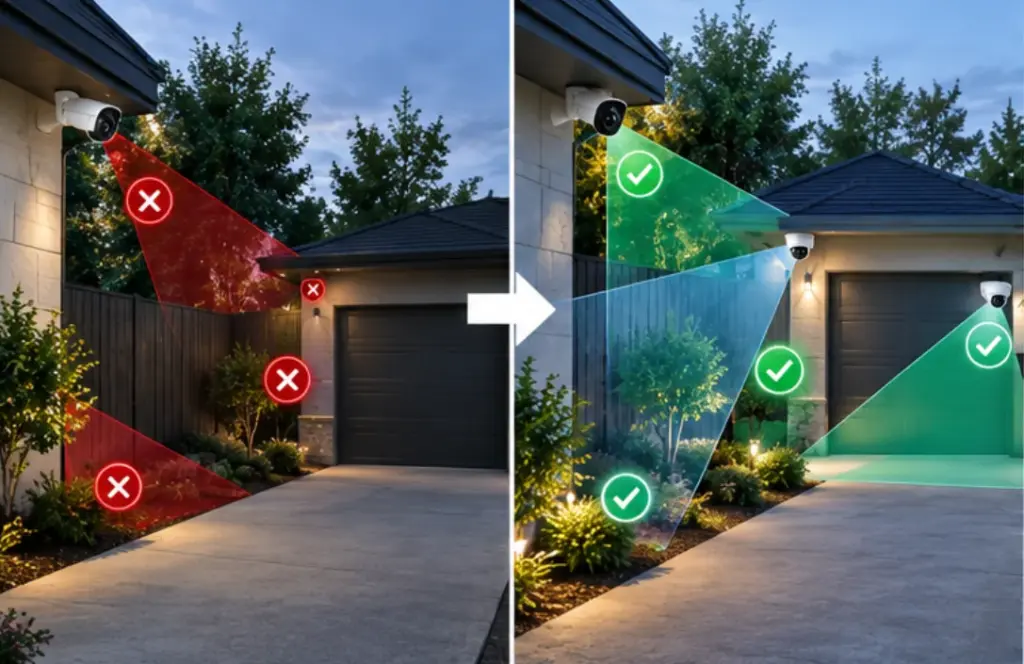
- The approach beside a garage or detached structure
- Areas immediately below or beside a camera
- Doorways viewed from an angle that makes faces difficult to capture
- Backyard gates and narrow paths between structures
- Driveways where vehicles or landscaping obstruct the view
- Indoor transition points such as stairs, hallways, and secondary entrances
Start With Entry Points and Approach Paths
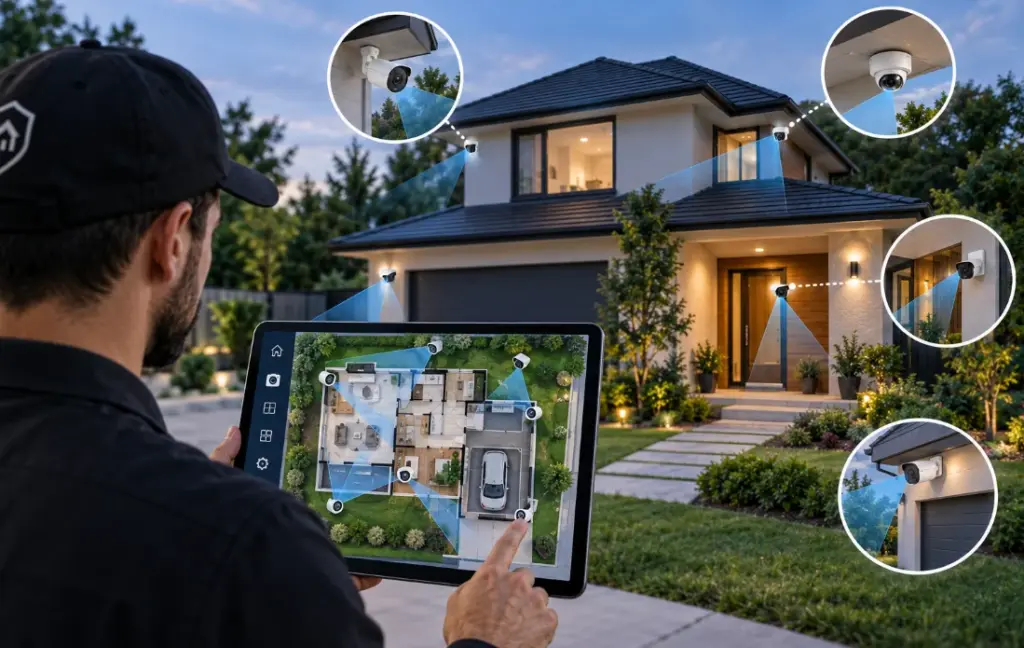
Do not begin by asking, “Where can I mount a camera?” Begin by asking, “How would someone approach this property?” Map the front door, garage, driveway, side gates, backyard access, basement or secondary doors, and other realistic approach routes.
These locations form the backbone of a coverage plan. A camera should ideally provide useful visibility before a person reaches the protected entry point, rather than only recording the doorway itself.
Look for Overlap, Not Just Coverage
One camera can show an event while another camera provides the context. Strategic overlap can help with handoffs between zones—for example, from a driveway camera to a front-entry camera or from a side gate to a rear-yard camera.
Overlap does not mean every camera should point at the same area. It means important movement paths should not disappear between fields of view.
Check Camera Height and Viewing Angle
Mounting height changes what a camera can actually prove. A very high camera may provide broad scene awareness but make facial detail harder to obtain. A camera mounted too low may be easier to tamper with and can produce an awkward viewing angle.
When planning placement, consider the distance to the target, mounting height, horizontal and vertical field of view, lighting, and the level of detail required. DORI concepts—Detection, Observation, Recognition, and Identification—can be useful when evaluating whether a camera position is doing the job you expect; try our security camera DORI calculator.
Don’t Forget the Areas Directly Below Cameras
Wide-angle cameras can create a false sense of security because their image looks expansive. The area close to a wall or directly underneath the mounting position may still be poorly covered.
This is especially important around exterior walls, gates, porches, and narrow side passages. Walk the property and compare the physical scene with the actual camera image instead of relying only on the advertised field of view.
Test Nighttime Coverage Separately
A placement that works during daylight may perform very differently after sunset. Headlights, porch lights, reflective surfaces, shadows, and infrared illumination can all change the usable image.
Review each critical approach after dark. Check whether faces are washed out by bright lights, whether a person disappears into a dark background, and whether nearby objects trigger excessive motion events.
Protect Privacy While Improving Security
Good coverage is not the same as maximum surveillance. Avoid unnecessarily recording neighboring properties, bedrooms, bathrooms, private indoor areas, or other spaces that do not contribute to the security objective.
Privacy masks, activity zones, appropriate camera orientation, local storage options, and network segmentation can all be part of a privacy-conscious design. For broader guidance, see the Smart Home Privacy Guide.
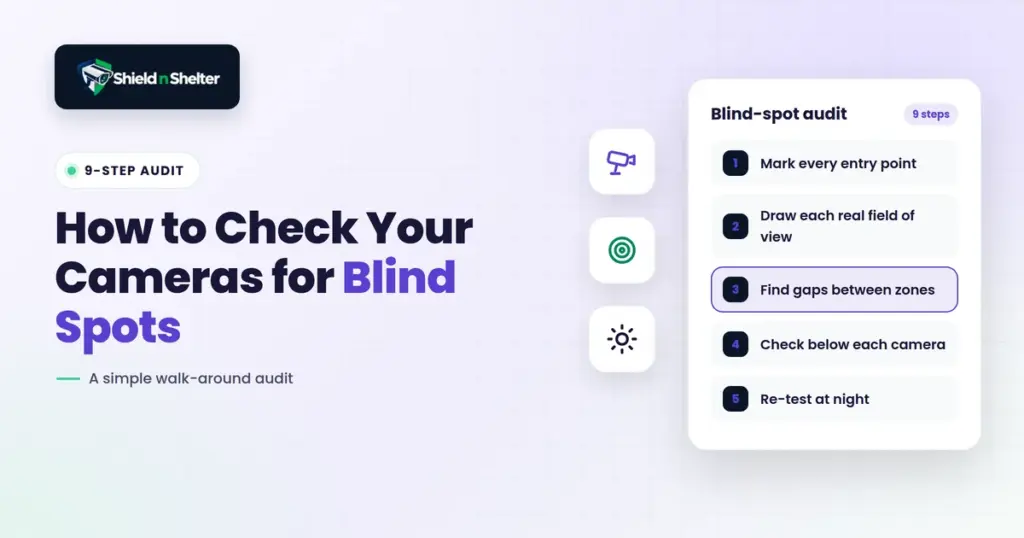
A Simple Blind-Spot Audit
- Draw the property perimeter and mark every entry point.
- Mark gates, driveways, garages, paths, and other approach routes.
- Draw each camera’s real field of view on the floor plan.
- Identify gaps between adjacent coverage zones.
- Check areas immediately below and beside each camera.
- Review identification distance rather than viewing width alone.
- Repeat the review at night and in difficult lighting.
- Check whether any camera unnecessarily captures private or neighboring areas.
- Prioritize changes based on risk instead of simply adding more cameras.
When More Cameras Are Not the Answer
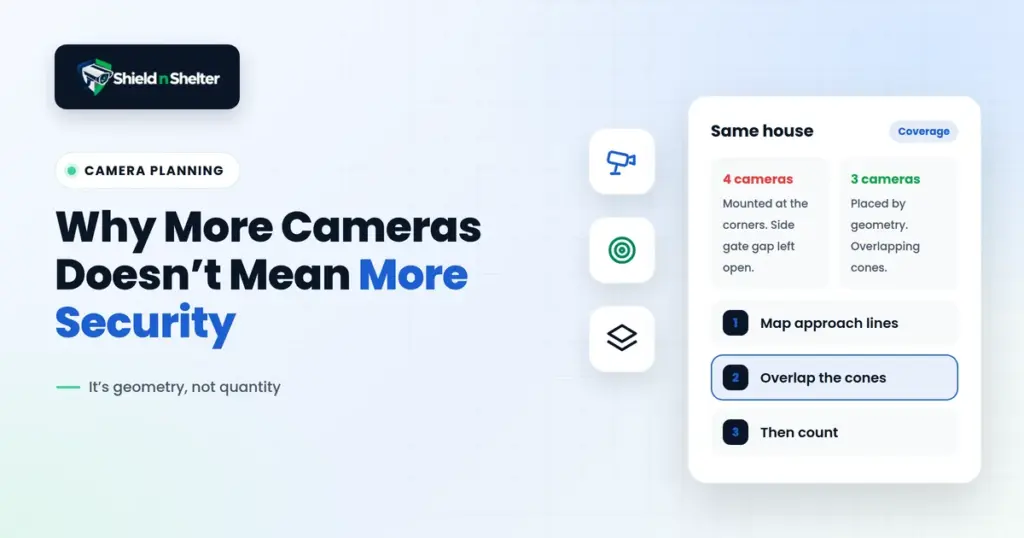
If a system has a blind spot, adding another camera is only one possible solution (see how many security cameras you need). Repositioning an existing camera, changing its mounting height, improving lighting, adjusting activity zones, or changing the lens can sometimes solve the underlying problem more effectively.
The objective is a coherent security architecture—not the largest possible camera count.
Final Takeaway
The most useful home security camera system is built around the property’s risks, approach paths, lighting conditions, privacy boundaries, and required evidence. A floor plan and coverage map can reveal problems that are difficult to notice when looking at cameras one at a time.
If you are planning a new system or trying to fix an existing one, Shield N Shelter’s Camera Placement Planning service can be used to develop a property-specific coverage plan rather than relying on generic camera placement rules.