
Spoiler Alert: It’s About Geometry, Not Quantity.
Here’s a scenario that plays out in driveways all over the world: Someone purchases an 8 camera security system and installs all of the cameras on the first night, thinking they are a fortress commander… until six months later, their driveway is cleared of a package and they have never ever noticed the person walking the side yard.
More cameras. Less security. How can this even be possible?
It’s because most people and most “starter kit” marketing thinks of security cameras as light bulbs. Looking to light a larger area? Add more bulbs. Looking for a larger home? Add more cameras. But cameras are not light bulbs. Like flashlights in the dark, each one reveals only a cone-shaped portion of the world, and if you don’t pay close attention to how those cones overlap, you end up with a very costly (and very self-assured) sense of coverage.
This is the geometry problem that nobody discusses and the actual answer to the question “how many security cameras do I need?“.
Cameras See Cones, Not Circles
Each camera has a field of view, called FOV — the angle of the world that it can see. The standard angle for most security cameras is in the 90 to 110 degree range; wider cameras are above 130, and approaching 180 (fisheye) degrees.
A “wide” camera is one that seems to look at all things in the immediate vicinity but the truth is – It doesn’t.
It sees a wedge.
If you walk out of that wedge, even a foot, you’re no longer recorded! Now here’s where it gets tricky: FOV doesn’t just depend on the angle, it depends on the angle and distance and height.
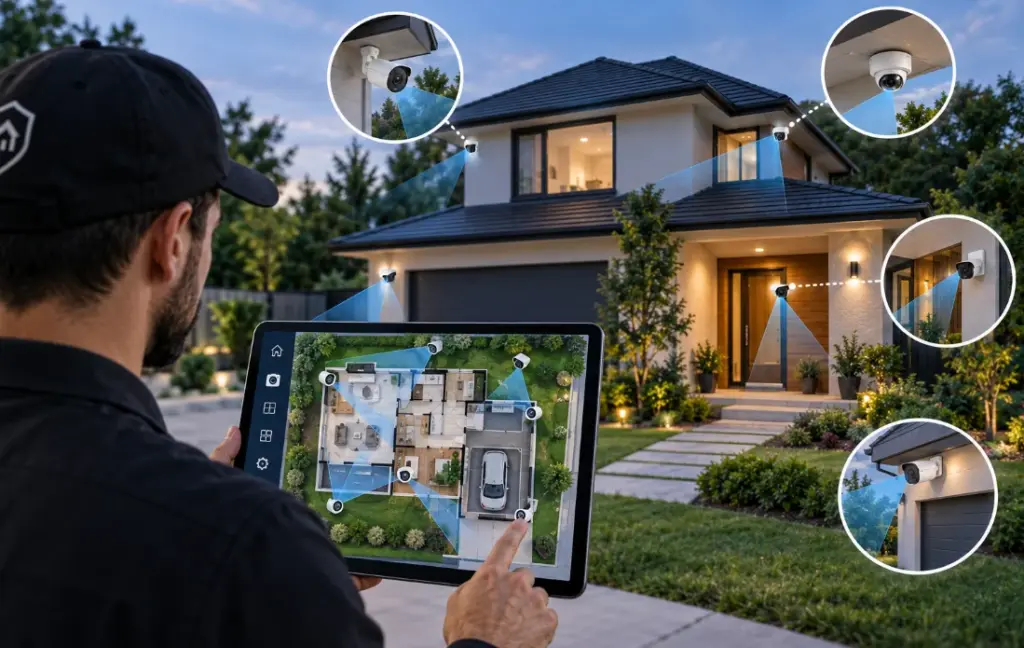
A camera at too low a height, angled off too far or obstructed by a fence post, a parked car or your own bush that sprouted 3 feet since spring doesn’t just have a smaller cone, it can have a cone with a piece missing. If you purchase four cameras and mount them at the four corners of your house, that feels right, you haven’t secured your property. You’ve installed four visibility wedges, but have not coordinated them.
This is how you get a home security blind spot right down your own side gate, and a camera with its lens pointed at that general area.
A Quick Before-and-After
Picture a typical suburban home.
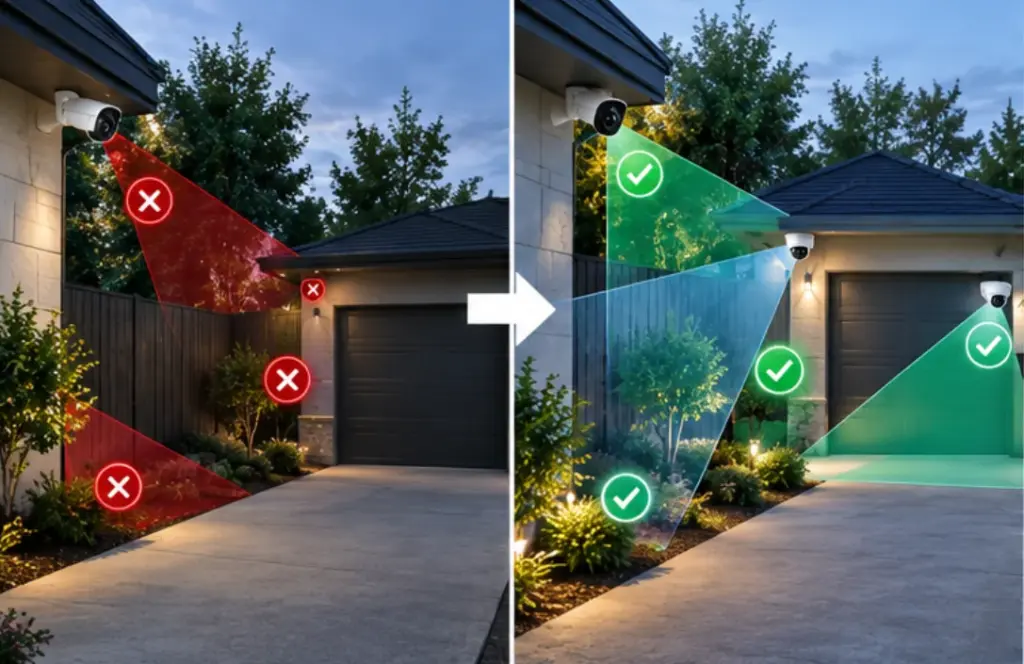
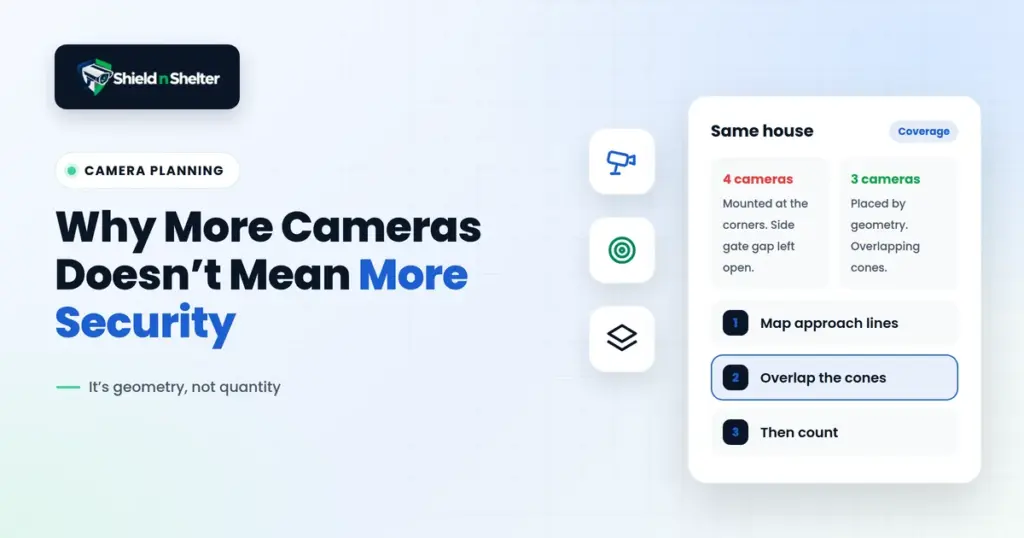
The owner installs 4 cameras; front door, driveway, back patio and one side of the house. In theory, it is 4-sided, 4-eyes coverage. In reality, the side camera is attached to see the fence line but it only covers up to the fence, but not quite the fence line between the house and the neighbour’s fence.
That gap is the only entry into the property nobody is inspecting and it’s just the kind of entry any casing of a house will look for.
Imagine the same house, but with only three cameras installed in the house, not at the compass points, but at the points in the house where the geometry suggested.
One camera is moved to a corner area where its cone overlaps with the driveway camera’s cone, thereby eliminating the overlap. The side-of-house camera has moved a few feet and the tilt is a bit, so that the camera field of view now overlaps the gap near the hedge, rather than ending at it.
The conclusion: fewer devices, fewer blind spots, and every approach to the house is covered by at least one (and often two) overlapping fields of view. It’s the whole idea, just in miniature. Whether it’s device count or coverage quality, it’s always coverage. More cameras strategically placed with a little overlap will be more secure than four cameras placed “obviously”.
Why “More Cameras” Became the Default Advice
It’s not surprising why the industry is this way. If the buyer has a modest townhouse and three cameras, if they are used properly, this is enough for me to suffice. Then you’ll see this box that says “8-camera kit” and it should appear to be more valuable.
Bundled kits don’t cost as much, or leave as much an impression on your shelf, as they do on your geometry. In a large box aisle, no one is measuring the fence line or sightlines from your side gate, just like the size of the kit is one-size-fits-most, and when nobody’s grading on the sightlines, most is a very forgiving size.
Unfortunately, many home security systems aren’t designed …they’re distributed at best. Cameras are strategically placed anywhere a convenient eave or outlet is available and there’s coverage, not guaranteed.
How you can have more cameras than your security conscious neighbor, and actually have worse coverage than he does!
So How Many Security Cameras Do You Actually Need?
In nutshell – Less than you might expect, but more than you would imagine.
The reality is that it’s not just a number, it’s a design process, and it’s more like this:
- Draw the lines of approach, not the walls. Don’t say “front, back, left, right. Consider all ways someone might be able to get onto your property, walkways, gates, gaps between fences and hedges, the side of the property that no one takes a look at.
- Don’t just cover, overlap! Two cameras viewing a little of the same zone are worth much more than two cameras each viewing their “own” separate zone with a seam between them. To make the individual wedges into a continuous net, you need to overlap them.
- Understand distance/detail compromise. A technically OK camera mounted 60 feet away and with a wide angle lens on your driveway may only capture a person as a smudge in the picture. If it cannot identify (check with a security camera DORI calculator), it will not cover and a witness that cannot testify will not testify.
- Opt for elevation and angle, not for comfort. Even if the existing eave, the pre-drilled hole, or the area with the strongest Wi-Fi signal makes the camera the right angle, it means nothing if it ends up in the wrong position to see what you want.
- Only then, count. After you’ve figured out the approaches and overlap, you will likely discover that the number of cameras you need isn’t a marketing level; it depends on the actual shape of your property and is usually three, six, or fewer.
The Real Upgrade Isn’t Another Camera
If you already are sitting down with a bunch of cameras and still feel uneasy, resist that urge to reach for a fifth or sixth unit. Instead do this – Walk your property and trace each camera’s actual cone of vision at ground level, in daylight and at night. Here is how to check your security cameras for blind spots step by step. You will find that the fix isn’t more hardware at all and it’s moving two cameras a few feet and adjusting their tilt to get their desired view.
It isn’t a numbers game. They’re a geometry problem wearing a shopping-cart costume. Solve the geometry first, and the right number of cameras takes care of itself.
FAQs
Do more cameras mean more security?
Absolutely not, it always depends on the geometry of the position of your camera and your home’s architecture. We recommend consulting with a firm for an optimised layout for camera position.
Can a concentrated set of cameras actually attract criminals?
In some cases, yes. More cameras may give the impression that your home possesses valuable objects that need high security which may have the reverse effect on the criminals.
How to set up the camera efficiently?
To set up efficiently, you must examine the layout of your home in both daytime and nighttime, and list down every possible view that you can get and later narrow it down to your want. You can align it with the camera eye or consult a professional firm like ours!