
Before We Start: The Safety Bit
Yeah, it’s the boring part. But please don’t. It takes one minute, yet the most important part of this article.
- Turn off the breaker. Go to your electrical panel and switch off the circuit, not just the wall switch.
- Test every wire. Use a non-contact voltage tester, the pen-shaped kind that beeps when it’s close to live power.
- Warn the household. Tell everyone at home what you’re up to, so nobody flips it back on while you’re up a ladder.
- Know when to stop. If you can’t identify the wire malfunction, call a licensed electrician.
- Check your local rules. Better be safe than sorry!
Note to the reader: This guide is not a substitute for electrical work. It is supposed to help you to understand what you are seeing. Your local code and the fixture’s manual always prevail.
So, What’s With the Red Wire?
You remove an existing motion sensor light fixture, only to find that there are two wires and a ground. Rather, there is a red wire, which is not matched in the ceiling. Cue the mild panic.
The good news: The red wire is not weird; it makes sense.
Most motion sensor lights have a red wire that supplies power to the light from the sensor. That’s it. Imagine that the sensor is like a doorman. Power is at the door, and when the doorman sees a movement, he lets it pass through the red wire to the bulb. He closes the door when the movement comes to a halt.
If you’re wondering who we are: Shield N Shelter is independent and engineering-based. We do not carry hardware and do not have any affiliates, so you will find only how it works here.
The Standard Wire Colors (US and Canada)
On most motion lights sold in North America, the colors go like this:
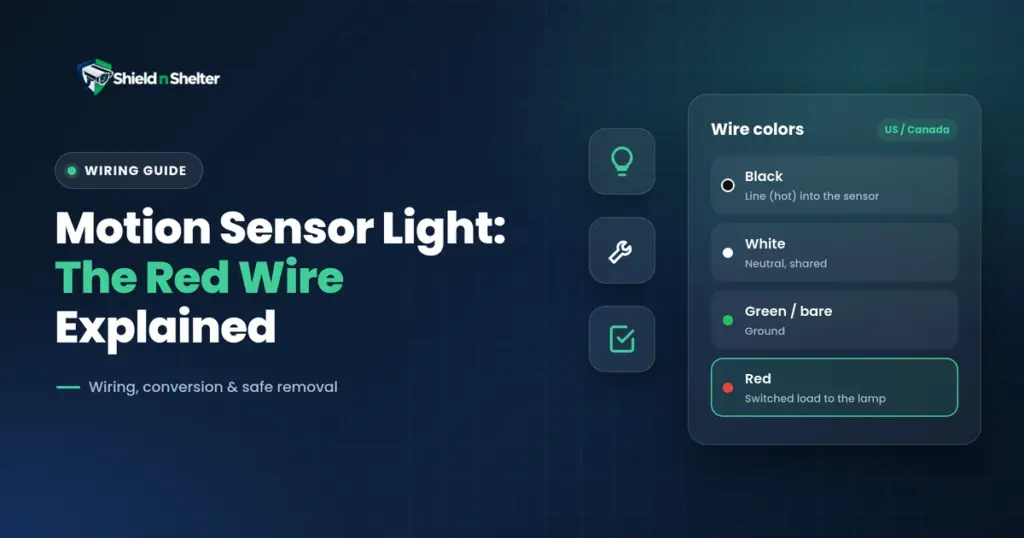
| Wire color | What it’s called | What it does |
|---|---|---|
| Black | Line (hot) | Brings power from your house to the sensor |
| White | Neutral | Completes the circuit, shared by the sensor and lamp |
| Green or bare copper | Ground | Safety path to the fixture body |
| Red | Switched load | Carries power from the sensor to the lamp |
Here’s how it can work step-by-step:
- The black wire supplies power and awakes the sensor.
- The sensor detects a change in motion and operates a small switch within the sensor known as a relay.
- Power goes from the red wire to the bulb and the bulb lights up.
- The rest of the circuit is made up of the white line, which brings electricity back home.
Remember, the red wire is energized when the light is on as well, and can shock you just as much as the black wire. Just because a light looks off, that doesn’t make a wire safe. That is only the breaker and your tester that will tell you.
Common Variations You Might Run Into
Real fixtures don’t always match the neat table above. Here are the usual suspects.
The standard three-wire sensor. Three wires (black, white, red, and ground) come off the sensor. Your house wires connect to the black and white, and the red wire is connected to the lamp. It looks like the standard configuration.
Dual-head floodlights. Two lamps – you might find two red wires (a red and a blue). Every one has its own lamp head but it is all powered by the same sensor. Follow the fixture’s diagram. Follow the diagram of the fixture.
Sensors with a manual override. Some have a second wire, usually blue or yellow, whereby the light can be switched on by a wall switch. It alters everything’s behavior; read the instructions before connecting.
Plug-in sensor modules. There are lights on porches and ceilings that have a separate sensor that can be plugged or twisted into the light. Then, the switched power goes to a standard bulb socket (or you can use a motion sensor light bulb instead).
Different colors in different countries. Many people are fooled by this one. Brown is live, blue is neutral, and green/yellow is earth in the UK. In countries that adopt older conventions, or IEC-style conventions, such as a portion of South Asia, red may be used for a live wire while black may be used for a neutral wire. A red wire in your wall may not be the switched wire that is on the fixture, but rather a live supply. Don’t guess if wall colours are not similar to the fixture’s. It’s a good time to call an electrician.
How to Turn a Motion Light Back Into a Regular Light
Maybe the sensor goes off every time a kitty walks past at 3 a.m. Maybe it has just died. Either way, you’d like a light that comes on when you flip the switch and nothing more.
This is possible on simple setups. It does change the circuit, though, so go slowly and only if your local rules allow it.
- Turn off the breaker and test the wires.
- Before touching anything, take photos of all connections.
- Unplug the black (line) and red (switched) wires of the sensor from the fixture.
- Instead of the red wire, the hot wire of the house should be connected directly to the hot wire of the lamp.
- Use an appropriate wire connector suitable for the task.
- Keep the white wires and the ground connected.
- Cap unused sensor wires, one at a time, or remove the sensor if the fixture can accommodate this. Switch the power back on and test light operation using the switch.
There’s an easier route too. If the sensor is built into the fixture, swapping the whole thing for a plain light is often neater and easier to inspect than a workaround.
And if your light is on a dimmer or a 3-way switch, or you can’t tell which wire is which, stop here and get professional help. Wrongly wired bypasses cause flickering, hot bulbs, and tripped breakers.
How to Remove a Ceiling or Wall Sensor Cleanly
Taking a sensor down is one thing. Leaving the wires safe afterwards is the part people forget. An open box full of bare wires is a real hazard.
- Shut off the electricity and verify all wires.
- Support the fixture while you are taking it apart to prevent it from hanging from the wires.
- Separate the wires and note which is line, neutral, and ground.
- Install a wire connector on one of the live wires at a time.
- Do not twist two live wires together, simply to tidy up.
- Never touch neutral or ground wires with a hot wire.
- Use a blank cover plate to close the box.
- Wire connections are required to be inside a covered and accessible box in most other areas.
Seal any hole in a wall or ceiling and seal any gaps around the outside of the wall where water can get in. If it remains energized, mark the breaker and inform all in the home. But if the box is filled with excess additional wires or if it is not securely anchored, then that is a task for a professional.
Mistakes That Trip People Up
- Entrusting the wall switch.
- Assuming colors always mean the same thing.
- Reusing damaged wire connectors or leaving bare copper showing.
- Skipping the ground. On a metal fixture, a missing ground can turn a small fault into a shock.
- Ignoring outdoor ratings. Outside lights need weatherproof boxes and gaskets.
The Bottom Line
The red wire only controls the light on/off. If the sensor LED is flashing instead, see what a motion sensor light blinking red means. After seeing it this way, anything to do with wiring, converting, and removing a motion light isn’t as bad.
There are many variations in color by country and by the age of the building, and older wiring may have hidden surprises.
If it is more than a “like-for-like” swap or if it is a job required by the local electrical code, switch off the breaker, test all wires, take pictures before disconnecting, and call in a licensed electrician to finish the job.