
One night, you set a motion-sensor light bulb in a lantern-style fixture on your porch and wait. (Replacing the whole fixture instead? Read about the motion sensor light red wire first.)
Nothing happens. No trigger, no light, no movement—even if you wave your arms in front of it.
The bulb isn’t flawed. It’s glassed in, and that is a physics issue and not a product issue. This guide is for both parts of the motion sensor light bulb puzzle – the nuts and bolts of the replacement, and there is another real reason that glass is not detected … which is followed by what really does work.
If you are wondering about us being biased, we do not advocate for any products or manufacturers and do not sell bulbs or sensors. This is the easy engineering version.
Two Different Products Share One Name
There are two different types of products that fall under the category of motion sensor light, and when buyers get these two mixed up, it’s where most of their purchasing blunders begin.
A motion sensor light bulb is a standard base light bulb that has a tiny PIR (passive infrared) sensor embedded in the bulb. It fits into a standard fixture and even serves the sensing function without the need for a separate detector or changing wiring.
A motion sensor light fixture is a fixture that includes the PIR sensor in its housing, and the other bulb(s) serve only to create light. If that fixture starts flashing, here is what a motion sensor light blinking red means. The fixture detects; the bulb doesn’t. Once you know the type you have, you will know whether it’s a $12 bulb replacement or will require a full fixture replacement.
Replacement Mechanics: What Actually Matters
Base fit. Most North American fixtures use a medium E26 base, while candelabra E12 bases are used for smaller fixtures and some decorative fittings. When purchasing, inspect the base of the light bulb you already have before buying one with a different base.
Wattage rating. All enclosed fixtures have a maximum wattage printed on them that is normally located inside the fixture housing. The wattage rating of the LED motion bulb is important, not the “equivalent” wattage rating. Enclosed fixtures trap heat, and because LEDs are more sensitive to temperature fluctuations than traditional incandescent bulbs, running them at maximum fixture limits inside an enclosure will drastically reduce their operating lifespan.
Dimmer incompatibility. Motion sensor light bulbs are not dimmable, and mounting a motion sensor light bulb on the dimmer switch is one of the most common and preventable light bulb problems. A dimmer operates simply by chopping the AC waveform, lowering the average voltage, which a standard bulb’s filament or LED driver will tolerate, but will cause confusion to the motion bulb’s on-board sensor circuit. The circuit may malfunction and cause the photoelectric sensor to fail to trigger, or the sensor circuit to degrade entirely.
One solution that we vouch for: Motion sensor bulbs should have a standard on/off switch, and they should be capable of operating on full voltage, with no exceptions.
Smart switch incompatibility. It’s a trick that’s so often used that people get caught. The light bulb with a motion sensor must have a constant power source at the wall switch; the sensing must appear at the bulb, and if the power is cut off by the switch, then the bulb cannot perceive anything and cannot turn itself on.
Many smart switches operate smart enough to trickle-charge the load when it’s nominally switched off to power their electronics, sufficiently to cause LED motion bulbs to flicker, glow feebly, or act in an impressive way.
The Physics Answer: Why Glass Blocks Detection
We’ll let you in on a little secret, and this is the true reason a motion sensor light bulb in a glass lantern, or a motion light behind a window, will not reliably turn on.
Unfortunately, PIR sensors (see occupancy sensor vs motion sensor) don’t detect light. They detect long-wave infrared (LWIR) radiation in the 8–14 micron band emitted by the human body at skin temperature. It all works like this: A warm body moves through the sensor’s line of sight, the infrared signature changes, and the sensor fires.
A window pane, a storm door, or a porch lantern made of ordinary glass (soda-lime) is a beautiful medium for transmitting visible light. job. But it does not transmit well with respect to long-wave infrared. The glass doesn’t transmit that heat; it is absorbed by the glass and re-radiated at the ambient or room-temperature heat signature, which is not as sharp as a moving body’s signature.
A human passing by a glass window is not being sensed as a moving heat source from the sensor side of the glass window. So the sensor is not actually measuring the glass’s own light, but rather the light reflected off the glass. This is why a PIR-based motion bulb in a glass fixture, or a motion light that is trained through a window, doesn’t work – it never does; it’s just the nature of the way the sensor works.
What Actually Works Through Glass
Two technologies sidestep this limitation altogether, because neither relies on thermal detection.
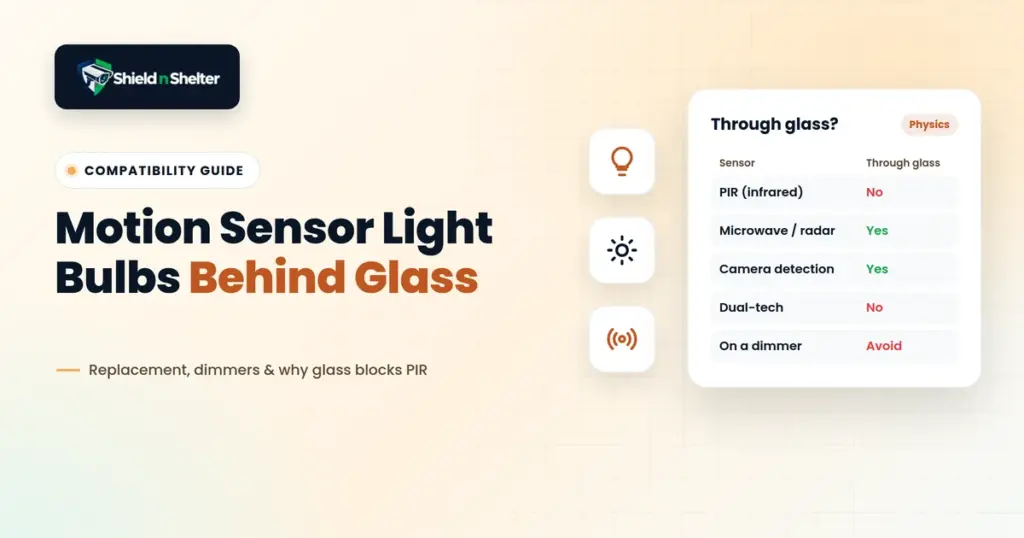
Microwave/radar sensors emit a low-power radio signal and estimate the Doppler shift in what bounces back. Since this is a radio-frequency signal rather than infrared light, it passes through glass and other thin materials mostly unchanged. A microwave-based motion sensor placed behind glass, or aimed through a window, will detect motion on the other side – the trade-off is that it can pick up motion you didn’t want it to, since it doesn’t stop cleanly at the glass either.
Camera-based detection works like standard security cameras using frame-differencing or AI-based person detection – it works through glass because it’s a visible-light (or near-IR for night vision) imaging problem, not a thermal one. A camera behind a storm door or window sees exactly what a person standing there would see.
Worth noting: dual-tech sensors, which need both PIR and microwave to agree before triggering, cannot solve the glass problem on their own. The microwave half would notice motion fine, but the PIR half never guarantees it, and since dual-tech is specifically designed to need both, an unconfirmed PIR half means no alarm fires. Behind glass, dual-tech only works if you can make it trust the microwave sensing alone.
What To Do About It
Our final advice – When your fixture is sealed glass, don’t battle with the physics with a better bulb.
The ones that really work: a PIR one that will have to be mounted outside the glass envelope completely, in the open air; a microwave-based motion fixture; or a camera or video doorbell covering that area (see where should a doorbell camera point), which does not have a thermal-detection issue.
FAQ
Can I put a motion sensor light bulb in an enclosed glass fixture?
If you want, yes. Functionally, it usually won’t trigger reliably, as the glass blocks the long-wave infrared the sensor depends on.
Will a motion sensor light bulb work on a dimmer switch?
No. Dimmers lower and chop voltage in a way that interferes with the bulb’s internal sensor circuit.
Why doesn’t my motion light behind a storm door or window turn on?
Because ordinary glass blocks the infrared signature a PIR sensor needs to notice a moving body.
What’s the real difference between a motion sensor bulb and a motion sensor fixture?
A motion sensor bulb senses and turns on its own in any standard socket, while a motion sensor fixture does the sensing in the housing itself.
Do microwave sensors have any downside if I change to one for a glass-enclosed fixture?
Yes, microwave motion sensors have a considerable downside when used inside glass-enclosed fixtures, so just use a PIR fixture with an exposed sensor.