
There’s a failure mode in home security that almost nobody plans for, because it doesn’t look like a failure. Everything is armed. All sensors report “healthy”. No alerts fire.
Yet somebody is standing in your hallway.
This isn’t a hypothetical or a scare tactic – it’s a known, predictable consequence of installing the wrong type of sensor in the wrong room. The difference between an occupancy sensor and a motion sensor is treated like marketing jargon, and both mean the same thing.
They are not synonymous. One detects change. The other is a presence detector.
In the security arena, that distinction is what makes a stationary intruder visible to your system or stealthy. Before you think we’re just here to sell – We are not a sensor company, we do not represent any manufacturer, and we do not make any profit from what you install.
So here’s the plain engineering version of how these devices work, where each belongs, and what actually goes wrong when you mix them up.
The Core Distinction: Change vs. Presence
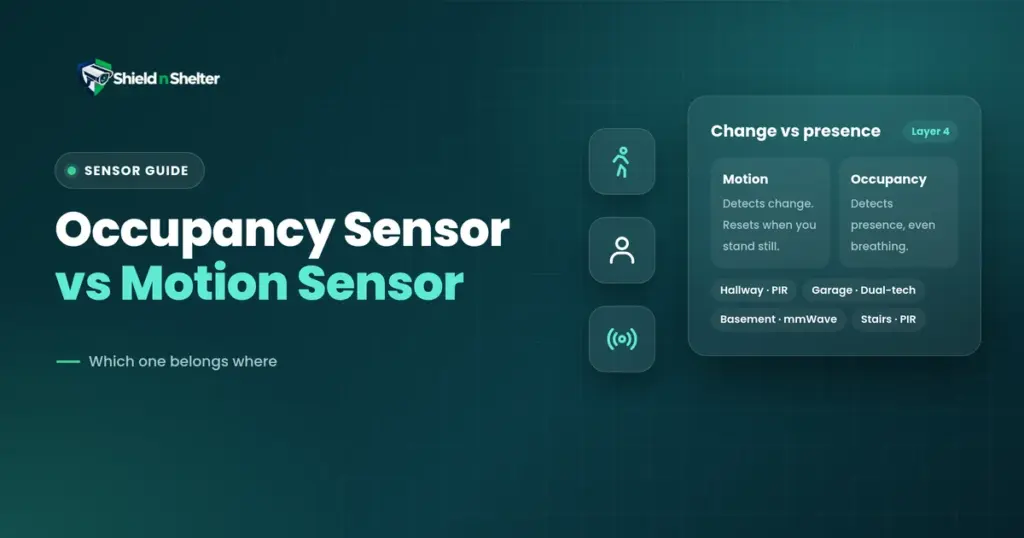
Motion sensors detect change. They’re looking for something to change in the area they’re monitoring, like a difference in infrared energy that passes across them, a change in a reflected signal. Something moved. Alarm.
Occupancy (or presence) sensors detect that a person is there at all, whether or not that person is moving. A well-designed presence sensor will keep the “someone is here” state for someone who is sitting straight on a sofa, standing still behind a door, or lying down.
That distinction may seem like an academic one, but take into account how an intruder acts. If someone is in a house they don’t belong in, they do not walk slowly and steadily. In they go, and then they listen. They are startled by a creaking floorboard. They stand behind a door and watch to see if the house reacts.
That sequence is no problem for a motion sensor. Gap is from the STOP.
The Five Sensing Technologies, Briefly
PIR (Passive Infrared) — the most widespread by far, and the most common type of security sensor in home use. PIR senses when the infrared energy changes between zones when a warm object moves across its line of sight. It won’t cost very much and doesn’t consume much electricity, and it won’t produce any emissions. It has a single limitation: It is essentially a change detector. Still, to a PIR sensor, you no longer exist.
Microwave — emits low-power microwave signals and measures how they return. Penetrates thin materials, covers more area, and has a finer sensitivity to movement than PIR. The downside is that it can pick up activity through walls and windows, so any activity on the other side of the room is a potential nuisance false trigger.
Ultrasonic — creates high-frequency sound waves; Doppler shift in the reflected sound. It is very sensitive to small movements, hence its presence in lighting control. It’s very susceptible to false trigger conditions, such as too much airflow, HVAC, and moving curtains, so it’s not usually used alone in a security application.
Dual-tech — uses two technologies, usually PIR and microwave, that must agree to activate the alarm. This will dramatically lower false alarms and makes it the logical option when a single technology would be triggered too often in a specific setting. The payoff: An agreement creates a double requirement, a bit of a trade-off, that can lead to slightly less sensitivity to true events.
mmWave presence sensing — the newest of all of them, mmWave presence sensing is the one that actually addresses the stationary-person problem. High-resolution millimetre-wave radar can detect micro-movements, such as breathing, small postural changes, and the involuntary movement of a standing body. When a person intentionally immobilizes himself, he’s still breathing, and mmWave is aware of it. This is why it is considered to be a presence sensor instead of a motion sensor.
Worth saying plainly: mmWave is costly, more complicated to tune, and just a bit too much in most rooms of most homes. It is worth its price in certain limited applications. The remainder of this article discusses how to find which ones.
The Failure Mode: When a PIR Resets With Someone Still Inside
Here is the sequence step-by-step, as the mechanics are more important than the warning.
When the PIR sensor detects an infrared change, it triggers a reset timer, which is usually between 30 seconds and several minutes (depending on configuration). If no change is noticed by the sensor after this timer, then the sensor goes back to its idle state. As far as the system is concerned, the room is now empty.
If someone walks into the house, actuates the sensor, and then stops moving – because they heard something, because they are waiting, because they are working on a lock or a safe, in one place – they will outlast that timer. The sensor resets. The room is well lit. Everything after that sensor is as if it’s no one’s house (lights, recording triggers, interior alarm arming logic).
The system isn’t malfunctioning. It is very much like a change-detector! It was just required to solve a problem it wasn’t designed to solve.
There’s a second-order version of this, which is arguably worse: PIR triggered lighting that turns off when someone is still there. The room is now being filmed without the light, and the footage you’ll actually need later is now degraded at the moment it was needed.
Where This Sits: Layer 4, Interior
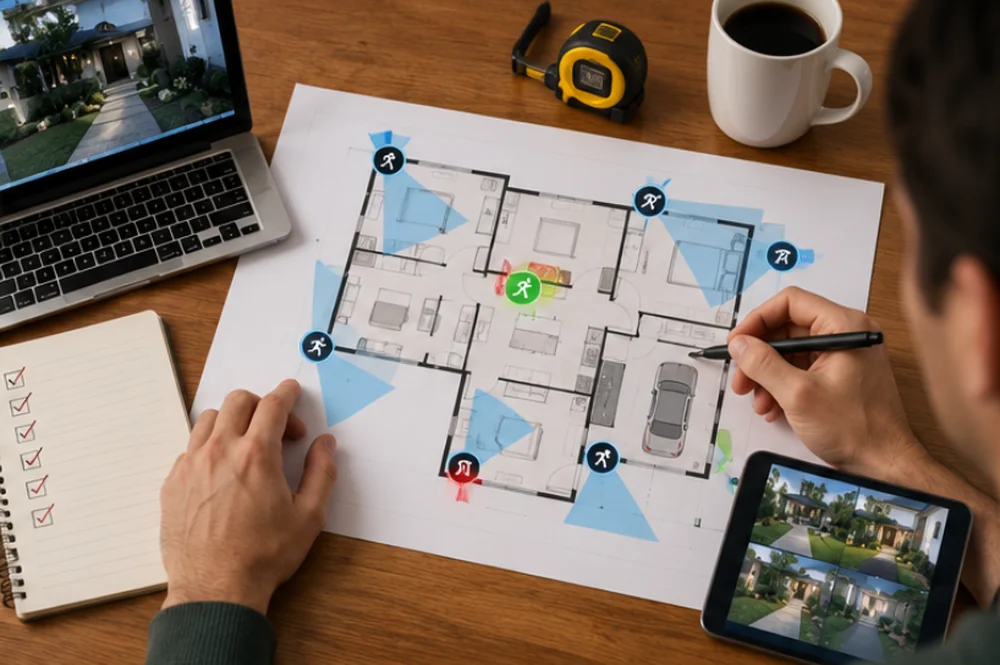
In our five-layer model, Layer 4 is Interior — the layer covering motion/occupancy sensors, indoor cameras, interior locks, and safes, sitting just past Layer 3 (Access Points: doors, windows, garage, locks) and just before Layer 5 (Life Safety: smoke, CO, fire, water leak). It is basically different from the layers above and below it. The outer layers are here for the pursuit of deterrence and approach detection. The whole design requirement is to keep an awareness of what is going on inside the envelope, and that awareness is continuous.
Deterrence tolerates gaps. Interior awareness doesn’t. An outer layer sensor that resets between events is getting the job done. The interior sensor cannot reset when a subject is still in the room, creating a blind spot in the one room where it is least welcome: your own home.
It is a good reason to give more consideration to interior sensor selection than is often given. The 4th layer is not “more motion sensors, but indoors. It is a problem that is different with different requirements.
Room-by-Room Selection
| Room | Recommended Sensor | Why |
|---|---|---|
| Hallway | PIR (or dual-tech) | Hallways are “transit” areas; people move through them and don’t hang out. It’s a perfect use for change detection, and PIR is reliable and has a low false-alarm rate for a high-traffic corridor. If the hallway has exterior-facing windows, dual tech. |
| Stairwell | PIR, positioned across the stair line | Another pure transit space, but positioning is more important than technology: place so bodies so that they do not move directly towards the sensor, the weakest angle for PIR to detect. |
| Garage | Dual-tech | Garages are the prototype false alarm environments – temperature fluctuation, vehicle heat soak, drafts, vibration from the door mechanism. A garage sensor actually can be disabled in a month because it takes two technologies to agree. |
| Basement | mmWave presence, or dual-tech | The best place to find true presence sensing in the average house is in the basement. They are low-traffic, typically with valuables or utility access and are just where someone stops and remains stationary for long periods. This is a room in which PIR reset is not theoretical, but real. |
| Bathroom | mmWave presence, or none | The last room where “stationary person” is not the exception, but the rule. Occupancy sensing is the only technically suitable type of monitoring for a bathroom — which you shouldn’t be monitoring, anyway. This should be based on privacy, and not detection. |
| Perimeter | PIR, or dual-tech outdoors | The requirement for approach detection is at the outer layers (perimeter), not in Layer 4. Change detection is correct. In areas where animals, foliage motion or passing vehicles would otherwise provide ongoing false triggers, the outdoor rated dual tech is used. |
The pattern worth noticing: transit spaces want motion sensing; dwell spaces want presence sensing. If a person has a fair reason to stay still in a room, or an unlawful reason to want to, that room is a presence-sensing candidate. If people only pass through, PIR is not a compromise — it’s the proper engineering choice, and spending more would buy you nothing.
The Practical Takeaway
Every home doesn’t need mmWave everywhere. What most homes need is PIR in the majority of interior functions, dual-tech in the two or three environments that would otherwise cause false alarms, and true presence sensing in more than one room where a stationary person is both reasonable and significant.
What most homes have, rather, is PIR everywhere, selected by price and availability rather than by room function; the basement and the bathroom, the two rooms where no one moves either way, are shielded by the one technology that goes arbitrary when nothing moves.
Getting this perfect costs less. It mostly costs considering each room’s function before picking the sensor, rather than after.
If you’d enjoy an independent read on which interior positions in your home warrant presence sensing and the ones that are perfectly well served by a $25 PIR, that’s the kind of question a Virtual Home Security Audit exists and is happy to answer.
And the best thing?
We’re not biased.