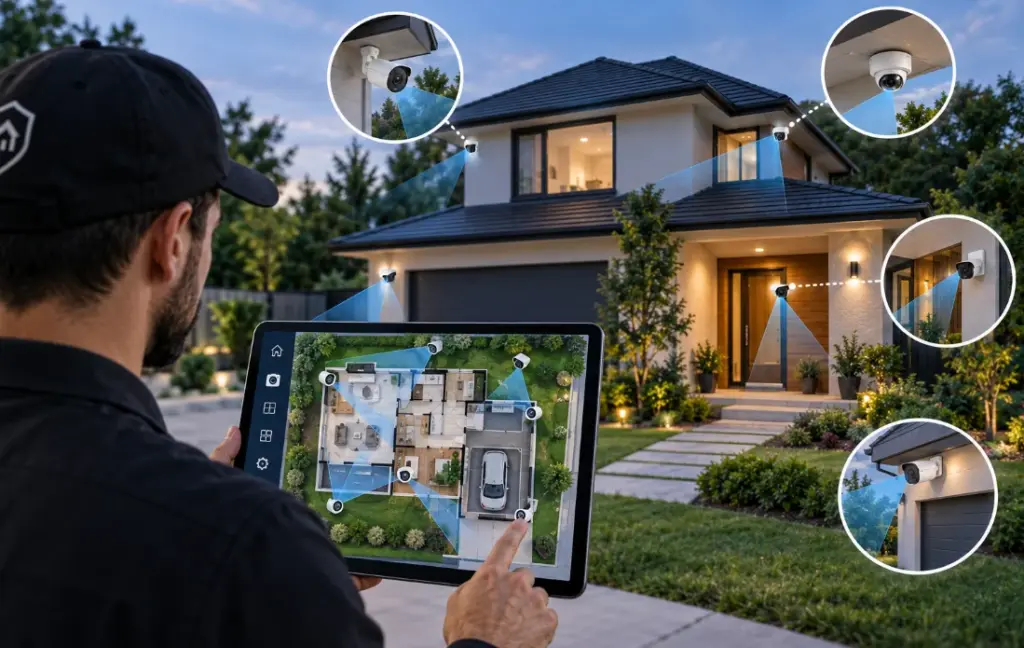

Thinking about blind spots in your home security? Do you think you may have missed a spot or that the coverage could have been more proper to stop break-ins? Well, it is not that difficult to notice the blind-spots. It is usually on the ordinary route or access points which may have just been out of your eyes.
It has been constantly shown in the FBI’s uniform Crime Reporting Data that a substantial amount of burglary occurs in the residential areas. In 2019, the percentage was at 62.8%, just before COVID.
In 2024, there has been a 71% increase in the theft of non-precious metals like iron, steel, tin, copper pipes, etc. over the last 5 years. Therefore, what you need to keep in mind is that security is not just about the front-door but finding out pathways where someone may approach your property.
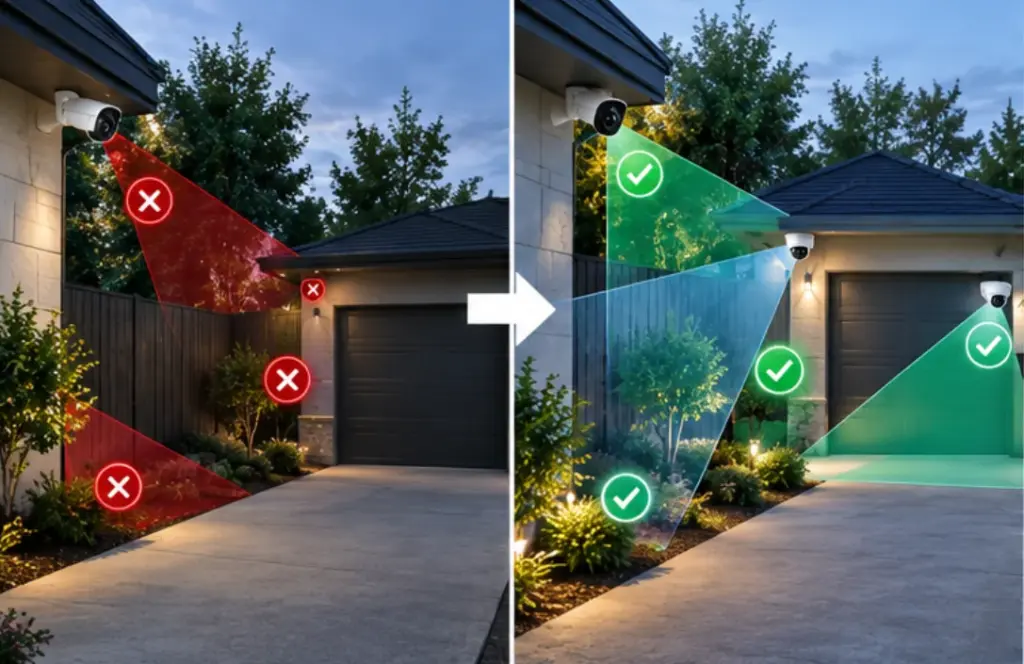
Now, what is a security blind spot? Well, a blind spot can be any area of your property from where a person can enter without being detected by the security system.
It can also be created by a poor camera angle or be behind the wall, fence, parked vehicles etc. The technical aspects like visibility, transparency, camera frame, brightness, and distance also can create blind spots.
For Example, a camera mounted too high by the front door may give a clear view of visitors on the porch, but completely miss someone walking up the side passages.
Similarly, a backyard floodlight can make the patio visible while leaving the gate, corner, and rear windows in darkness.
Therefore, a home is better protected when every route is assessed meaningfully in your home security coverage, not just because it has many cameras.
Entry-point percentages of burglaries should be understood as survey-based patterns—not a guarantee that every property faces identical risks. The precise risk depends on the home’s layout, locks, neighborhood conditions, visibility, and occupancy.
The Garage, many times, is an overlooked transition point. It is more than a palace to park.
It is the transition point between the interior of your home and the outside of it. If anyone enters the garage, they may remain not visible or not captured in the cameras while they go through your garage and find a way to the inside of your home.
It is reported that, though a small percentage, garages serve as the entry point of 9% of the burglaries.
A wide camera can capture a vehicle arriving, but a closer angle is required to identify the actions occurring in the garage.
That is why most entry point locations like the garage and their connection with the inner-house deserve more attention while establishing a good home security system. You can look for gaps in these points:
The space immediately beside the garage door, where a person can stand outside the camera’s frame.
A long driveway covered by a wide overview camera that cannot show facial detail at the garage.
The service door on the side or rear of the garage.
A detached garage with no view of the path between it and the house.
Poor lighting that turns the garage entrance into a silhouette at night.
Check around the property, start from the streets and walk towards the road. Ask yourself—
Can a person be seen continuously from the driveway to the garage door?
Can the camera distinguish a face, not just a moving shape?
Does the view include the service door and the door connecting an attached garage to the home?
The Side Gates and narrow side yards are one of the easiest pathways for a person to enter your property, and they are often forgotten. They give away roads to the backyard, shed, rear passages, even the ground-floor.
A side gate blind spot may happen if a front facing camera points toward the driveway while the backyard camera points toward the patio, leaving the spot out of coverage.
It matters as surveys on Burglary done by the InterNACHI shows estimated 22% of the burglars get into the property through the back door and 23% by the first-floor window.
That’s why putting emphasis on the rear entrances and windows should be assessed properly and not just be done with the front security system.
Remember, a camera angle across a narrow side path will generally catch better and clearer movements than a camera with angle straight-down. Here are the things you need to check, whether—
The gate latch is visible from a camera or the home.
The path is blocked by garbage bins, plants, a fence, or a shed.
A camera sees movement across the path rather than only the person’s back.
The area remains visible after dark.
Motion zones exclude non-essential activity while still covering the gate itself.
Ground-Floor is another very common way for a burglar to get into your house, because they are easy without climbing, often screened and sometimes even leaves unsecured passages for ventilation.
The InterNACHI burglary-resistance guidance cites first-floor windows as the entry point in approximately 23% of surveyed burglaries, second only to the front door in that survey.
Identify every ground-floor window from outside and assess them through these questions—
Is there a clear, unobstructed view of the approach?
Would a camera capture a person before they reach the window?
Is a tree, fence, or exterior structure blocking the image?
Does night footage show a usable image, or only glare and shadow?
Are the window locks, frames, and surrounding landscaping maintained?
Privacy is without question a top priority, however, the fences, big trees, sheds, outdoor furniture etc. in your backyard can obstruct the camera view. There are small but access points like rear door, sliding door, utility entrance, basement-access, and side-gate. Common examples of blind-spots in the backyard can be—
The far side of a shed or outbuilding.
The corner where a fence meets the house.
A back gate outside the field of view.
A patio camera that sees the seating area but not the rear door approach.
A camera mounted under the eaves but blocked by guttering, vines, or roof supports.
Night-vision glare caused by a nearby fence, wall, or light source.
The problem isn’t that all windows are a giveaway for the criminals, however, a few windows which can be—
Windows behind tall hedges or large shrubs.
Basement or low-level windows hidden behind patio furniture.
Side-facing windows beside a narrow passage.
Rear windows obscured by sheds, fences, or landscaping.
Windows beneath a deck, balcony, or roofline that blocks camera views.
You should be able to identify where a person enters the yard, where they travel, and where they could stand outside direct sight. Use camera with:
A perimeter view for gates and fence-line approaches.
An entry-point view for the rear door and nearby windows.
A verification view where a person’s face or activity can be seen clearly.
Note that no single camera has to do all three jobs. In fact, trying to make one device cover every backyard angle is why blind spots remain.
Ultimately, a smart home security strategy starts by noticing what the system “does not”. If you identify any uncertain areas, continue to the Camera Placement pillar for room-by-room geometry, height, angle, and coverage guidance. Then use the Security Assessment pillar to evaluate entry points, existing devices, lighting, locks, and system-level gaps.
The entrance most people get wrong is the one they look at every day. Where your doorbell camera should actually point covers why the default aim misses the person standing at the door.
Need Professional, Brand-Agnostic Guidance?
Shield & Shelter provides 100% independent residential security consulting with zero equipment markups and zero vendor kickbacks.