
A home security risk assessment is a structured review of how a specific property could actually be entered, scored and prioritised before any hardware is bought.
Most people don’t think about their home’s security setup until something goes wrong, a break-in on the street, a package theft, a doorbell camera clip that ends up going around the neighborhood group chat with forty “did anyone else see this?!” comments.
At that point the instinct is usually to buy something, a camera, a lock, one of those “Protected By” signs for the yard that studies suggest deters about as many burglars as a garden gnome does.
But buying devices without knowing where the actual weak points are is a bit like buying paint without knowing which walls need it.
A home security assessment fixes that problem before the shopping starts. It’s a structured look at a property’s actual vulnerabilities, not a sales pitch dressed up as an inspection, and it results in a clear picture of what needs attention and what doesn’t.
What a Home Security Risk Assessment Actually Covers
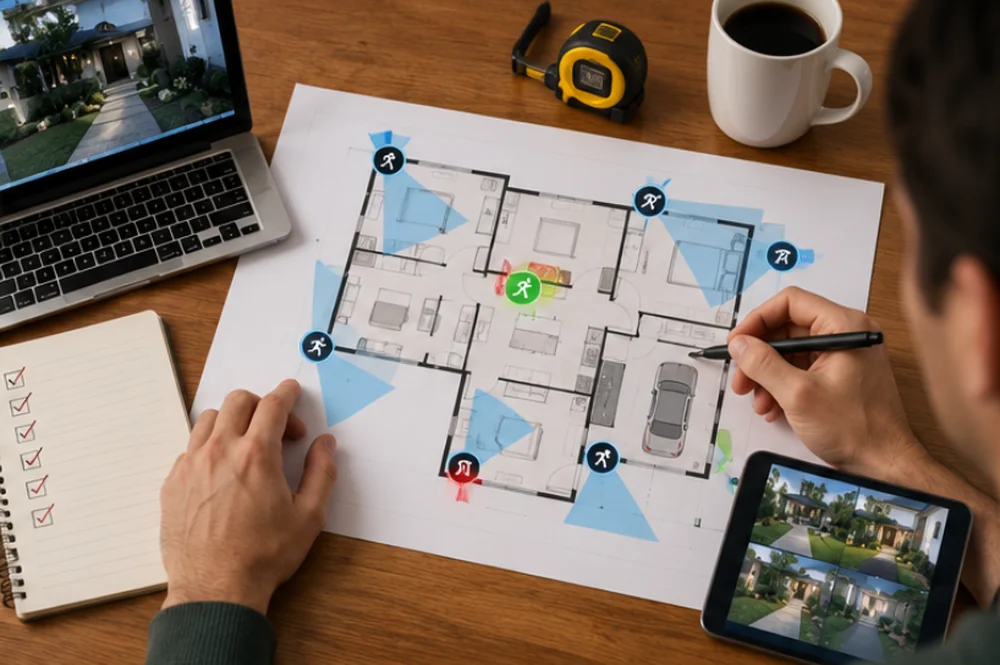
A proper assessment isn’t just someone walking around checking if the doors lock, though you’d be surprised how often that’s step one and reveals something. It looks at the property as a whole system, covering things like:
Entry points. Every door, window, garage access, and secondary entrance, including the ones that get overlooked like basement windows or a side gate nobody’s locked since the house was bought.
Sightlines and blind spots. Where can someone approach the house without being seen from the street, a neighbor’s window, or existing lighting.
Lighting. Exterior lighting coverage at night, motion activated versus static, and whether there are dark zones around entry points. Fun fact, most burglars are more deterred by good lighting than by an actual alarm sign, they just don’t love being visible.
Existing devices. What’s already installed, whether it’s configured correctly, and whether it’s actually being used or just quietly blinking in a drawer somewhere after the app update nobody bothered to finish.
Network exposure. Whether smart devices are segmented properly or sitting on the same network as everything else in the house, which matters a lot more than most people realize.
Landscaping and physical obstructions. Overgrown shrubs near windows, fences that block visibility, anything that gives an intruder cover, or honestly just gives a raccoon a good hiding spot before it sets off every motion sensor in the house.
Behavioral patterns. Things like whether packages sit visible on the porch for hours, or whether the same side gate gets left open on trash day every single week without fail.
The goal isn’t to generate a list of everything wrong with a property. It’s to prioritize, so the household knows what actually matters versus what’s a minor, low priority item that can wait until next spring.
Virtual Audits vs. Traditional In-Person Visits
This is where things have changed a fair amount in the last few years. Traditional security assessments meant someone showing up, walking the property with a clipboard, and mailing a report a week or two later, very much a “check your mailbox” era of service. That still happens, but a video-walkthrough audit, sometimes called a virtual security audit, has become a genuinely solid alternative for a lot of households.
| Virtual video-walkthrough audit | Traditional in-person visit | |
|---|---|---|
| How it works | Homeowner films the property with a phone, following a guided checklist | An assessor physically visits and walks the property |
| Physical testing | Assessed from the footage, no hands-on testing | Can try locks, check sensor range, inspect wiring directly |
| Scheduling | Faster, no travel involved | Requires arranging a site visit |
| Turnaround | Usually days | Historically a week or two |
| Best suited to | Straightforward suburban homes with a handful of entry points | Large or unusually laid out homes, or existing hardwired systems |
How a virtual audit works
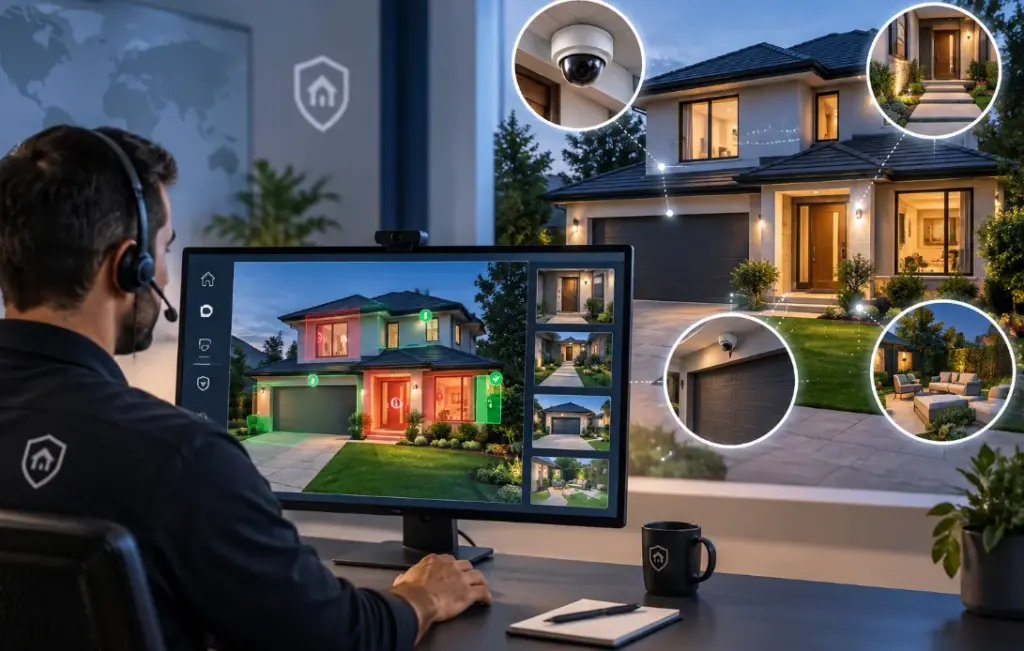
A homeowner walks their property with a phone camera, following a guided checklist, recording entry points, the yard, existing devices, and problem areas as they go. It’s basically a home movie nobody’s ever going to want to rewatch for fun, but it’s extremely useful footage. That footage gets reviewed by an assessor, sometimes live over a video call, sometimes asynchronously with a follow up call to walk through findings. It’s faster to schedule since there’s no travel involved, and it usually turns around in a matter of days rather than weeks.
How a traditional in-person visit works
An assessor physically visits the property, walks it in person, and can test things directly, actually trying a door lock, checking a sensor’s range, physically inspecting wiring on existing equipment. It’s more thorough for certain things, particularly larger properties, complicated architecture, or homes with existing wired systems that need hands-on inspection.
Neither one is strictly better, they suit different situations. A straightforward suburban home with a handful of entry points is usually well served by a virtual audit, it’s faster, cheaper, and covers the same ground a walkthrough would. A large or unusually laid out property, or a home with existing hardwired security infrastructure that needs physical testing, often benefits more from an in-person visit. Some assessments even combine the two, starting with a virtual walkthrough and following up in person only for specific problem areas that need a closer look, sort of a “triage first, then specialist” approach.
What a 0-100 Risk Score Actually Means
Most assessments end with some kind of scored summary, and the common format is a 0-100 risk score, similar in spirit to a credit score, minus the part where it follows you around for seven years. It’s not meant to be a precise probability of anything happening, it’s a relative measure of how exposed the property is compared to a reasonably secured baseline.
Generally speaking:
80-100 means the property has strong coverage across entry points, lighting, and monitoring, with only minor items left to address.
60-79 means the basics are in place but there are a handful of meaningful gaps, an unmonitored side entrance, weak exterior lighting, that sort of thing.
40-59 means multiple significant vulnerabilities exist, often including easy access points or a total lack of monitoring.
Below 40 means the property has serious, often basic gaps, things like an unlocked or easily bypassed primary entry, no lighting, no visibility from the street.
The number itself matters less than the breakdown behind it. A score in the 60s from a house missing one good camera angle is a very different situation from a score in the 60s from a house with a genuinely weak front door lock, even though the number looks identical on paper. That’s why the score should always come with context, not stand on its own as the whole result, a score with no explanation is basically a report card with no comments section.
What’s Inside the Written Report
The report is really the deliverable that matters, the score is just a summary line at the top of it. A solid assessment report generally includes:
- An overview and the risk score, with a short explanation of what’s driving the number.
- A prioritized findings list, usually broken into high, medium, and low priority items, so it’s clear what to address first and what can sit on a someday list.
- Photos or video stills from the walkthrough, annotated to show specific issues, a blind spot, a weak lock, a suspiciously dark corner of the yard.
- Specific recommendations, not just “add a camera here” but what kind, roughly where, and why that spot matters more than another.
- A network and device review, if smart devices are already in place, covering configuration issues and segmentation gaps.
- A rough cost and next steps section, giving a sense of what addressing the findings would realistically involve.
A good report is something a household can actually act on without needing to hire a translator for it. If it reads like a sales brochure for one specific brand of camera, that’s usually a sign the “assessment” was really just a product pitch wearing a clipboard.
Getting an Assessment Done
For anyone ready to actually get a property assessed rather than guessing at what needs attention, the Virtual Home Security Audit service walks through the whole process end to end, from the guided video walkthrough to the final scored report with prioritized recommendations.
FAQ
How do I prepare for a virtual security audit?Not much is needed ahead of time, no need to tidy up like company’s coming. It helps to have a phone with a decent camera and enough storage or battery for a 15 to 20 minute walkthrough.
Walking the exterior first, then each entry point, then the interior areas near windows and doors, tends to give the most useful footage. It’s also worth noting down any existing devices and whether they’re currently working, since that saves time during the review, and saves everyone the awkward moment of discovering a camera’s been offline since March.
How long does a virtual audit take to complete? The walkthrough itself usually takes 15 to 30 minutes depending on the size of the property. The review and written report typically come back within 2 to 4 business days, faster than a traditional in-person assessment, which can take a week or two once scheduling and travel are factored in.
Does a low score mean the home is unsafe to live in? Not really, a lower score just means there are more gaps to close relative to a strong baseline, not that anything catastrophic is imminent. Most homes start somewhere in the middle and improve significantly with a handful of prioritized fixes rather than a complete overhaul or a full remodel.
Can a virtual audit replace an in-person visit entirely? For most standard homes, yes. Larger or more complex properties, or ones with existing hardwired systems that need physical testing, usually benefit from at least a partial in-person follow up.
Is the report tied to specific products or brands? It shouldn’t be. A good assessment report focuses on what needs to happen, coverage, placement, configuration, not which brand to buy. Product recommendations, if included at all, should come secondary to the actual findings, not the other way around.
An assessment is most useful before you have committed to anything, which is why it pairs naturally with a move. The new homeowner’s setup guide applies the same thinking to a house you are about to occupy, and the first 24 hours checklist is the compressed version for the day you get the keys.
Need Professional, Brand-Agnostic Guidance?
Shield & Shelter provides 100% independent residential security consulting with zero equipment markups and zero vendor kickbacks.