
You want to feel safe within your home. Yet, as a leaseholder who shares responsibility for the door, you may have skipped an “alterations” clause in your rental agreement.
Can you add a chain? Are you able to lock your bedroom door? What happens when your landlord puts a lockbox on your front door?
The following are three of the most frequent renter security questions, and the truthful answer to each one is “it depends.”
This guide explains what it depends on so you can start asking the right questions, and it lists ways you can feel safer without touching the door.
Please note: This is general information only, and not a legal document. Rules differ by state, country, and city, and depend on the wording of your lease. Don’t do anything until you’ve read your lease and looked at your local tenant law (your local tenant union or legal aid office will be able to help).
We do not sell locks or any hardware, and we have no payout for the selection you make.
The Four Ideas Behind Every Answer
Almost every renter lock question comes back to four principles.
| Principle | What it means for you |
|---|---|
| Lease clauses | Many leases say you can’t add or modify locks without written consent, and some say you must hand the landlord a key if you do. Your lease is the first thing to read. |
| Landlord right of entry | Landlords have a right to enter, but generally with notice (24 to 48 hours is common in many places) and an exception for real emergencies. Rules contradict widely, and some places say only “reasonable notice.” |
| Fire-code egress | Exit doors typically need to open from the inside without a key, special knowledge, or much effort. This is a safety rule, and it shapes which locks are sensible. |
| Damage vs. alteration | Drilling or screwing hardware in is usually an alteration. Anything that comes off cleanly and leaves no marks is much less likely to count. Deposit rules usually separate ordinary wear from damage. |
Keep those four in your head, and the three questions below get much easier.
Question 1: Can You Add a Chain or Secondary Lock to Your Door?
Short answer: Usually, but it varies based on your lease and the local law.
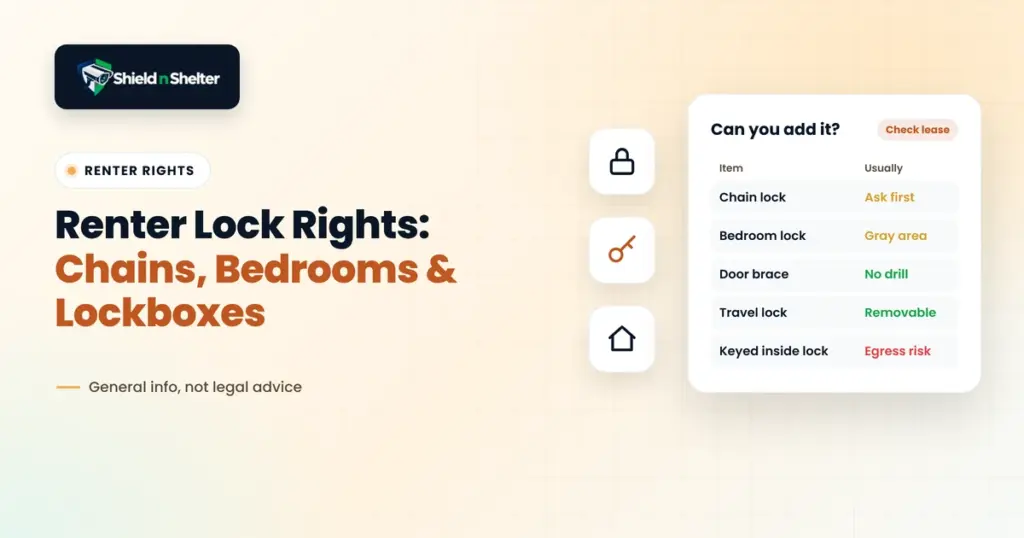
The door is secured to the frame with chains, slide bolts, and additional deadbolts. That places them a modification in most rentals, and several rentals have to have written authorization initially. Some also state that a new key for the landlord is due within a certain period of time if you change a lock.
Some landlords allow tenants to have the keys or locks re-keyed or changed, often with the proviso that the tenant will provide a key to the landlord immediately. Many don’t. Do not presume that your region does. It can be in violation of your lease and cause you to be on the hook for repairs if you do it without the knowledge of your landlord.
Safety-wise, it’s important to consider the egress principle. A chain or slide bolt that can be undone by hand from the inside – no key required – will more likely meet exit requirements than a lock that must be broken from the inside using a key. If ever you ask yourself, if it is good, could you get out quickly, in the dark, in a panic?
So what you do: You ask in writing, you keep a copy, and you ask if the landlord will install or approve one. Landlords may say yes, as it doesn’t cost them anything.
Question 2: Can You Lock an Interior Bedroom Door?
Short answer: Usually a gray area, and it depends on your living situation.
Whether an interior bedroom lock is important depends on your living situation – if you live alone, it won’t be much of a concern. A bedroom lock is a shared request when sharing with roommates, and frequently the lease determines it.
The same two concerns are true. A permanent lock to be screwed into the door is an alteration. A bedroom door is one of your exits, and if it is locked with a key that can only be put from the inside, that can be hazardous in a fire. The familiar, lower-risk type is those ordinary locks that open from the inside with a thumb-turn; these require permission to install.
If you’re in a shared rental, and the lease states that each tenant is responsible for their own room, read the lease for details on locks and access. There are some arrangements where each room is different.
What to do: Read the lease, ask your landlord/housemates, and if it’s not clear, one of the removable options below. For closets and interior storage, see how to lock a bifold door without damaging the frame.
Question 3: Can a Landlord Put a Lockbox on Your Entry?
Short answer: it depends on your lease and local rules, but one thing doesn’t change: a lockbox is not a license to walk in.
A lockbox or small key safe may be used during a move-out, a showing or repairs. If there is to be one, the entrance conditions will apply nonetheless. Outside of a real emergency, the landlord will still require proper notice before entering the property in most locations.
It’s okay to be concerned about it. A lockbox leaves other people with a key to the door, and you might not know who it is.
Sensible questions to ask, addressing them in a respectful and written manner:
- Who possesses the code, and will it be altered following each visit?
- Will it be removed when it’s no longer needed?
- When someone uses it, can you be told?
- Who is responsible if it damages the door or railing?
Lockbox Screwed-On Modification – An alteration that is made to your unit by screwing a lockbox on. Before the door hangs up, ask and take photos of the door before and after.
Safer Without Drilling: What We Actually Recommend
In most cases, these are options that do not require permission slips, drill holes, or screws. No brands named and no product sold, just see what fits your door and budget.
- Portable door braces. A brace holds the door in place between the door and the floor, and prevents forced entry from the outside. It rests on the ground and typically doesn’t leave any stains, but be sure to test it won’t damage fragile floors.
- Travel locks. These mini, portable locks attach to the inside of the door or frame. They are designed for use in hotels and may also be used for rentals, as they are completely removable.
- Door-jam bars. Similar idea: a bar braces the door from the inside and lifts away when you leave.
- Removable-mount sensors. Sensors mounted to doors and windows with adhesive tape or without drilling. They can notify you as soon as an entry opens and when you move out.
One rule we apply to all of them: Can anybody in the house undo it the quickest inside, with one hand, no key, and no instructions? This is our own rule-of-thumb and not a legal test. If you cannot do it in the dark in two seconds, don’t do it. Anything that will keep you inside is worse than no lock. Explain how it works to all the family members at home.
Before You Do Anything: A Five-Minute Checklist
- Read the lease provisions for locks, changes to the lease, and entry.
- Look into entry notice and lock change regulations in your local tenant law.
- Request in writing and retain a copy.
- Take a picture of the door and frame before making any changes.
- Remove first, permanent second (unless approved).
If you’re requesting because you don’t feel safe, such as from a previous partner who has been involved in abuse, some locations offer special lock change protection. You can find out fast what is covered where you live from your local legal aid office or a domestic violence hotline.
Where to Go Next
Renting doesn’t signify you have to feel exposed. Start with our guide to home security for renters, then create a plan around your budget and lease with our DIY Security Planning service.
Both are designed for homes where you can’t change the hardware!
Reminder: this article is general information, not legal advice. Check your lease and local tenant law before making changes.