
Many renters carry the misconception that home security is a homeowner-specific agenda. But that couldn’t be further from the truth. Whether you own or rent the place, it’s important to maintain and implement a solid apartment security system for your personal safety.
That being said, a renter typically has less freedom than a homeowner. When you own the place, you get to break or build however you like to set up home security cameras around the property. However, with a landlord around, it’s not as easy to make whimsical adjustments.
So, how to ensure home security for renters without losing your deposit in the process? What can you install for your safety without getting on the landlord’s bad terms?
As a renter, you should avoid permanent installations and focus more on wireless sensors, removable mounts, and portable alarms instead. It’s also important to have an open discussion with your landlord to figure out what you can and cannot install independently.
In this write-up, we’ll go over the common ways you can bypass strict landlord guidelines and build a lease-focused security system for your rental property. We’ll cover no-drill devices as well as temporary/portable ones so you don’t have to face unnecessary move-out costs.
What’s The Renter-Safe Approach?
According to the FBI, as of 2024, property crime makes up over 83% of all the crimes in the United States. So, home security is non-negotiable whether you’re a renter or a homeowner.
However, renters must consider some additional factors. Such as:
- Lease Requirements/Restrictions: If you break down walls or windows and install security equipment without permission, you will lose your security deposit.
- Shared Community: Renters usually need to share their living space with other members of the community. By installing cameras without informing them, you might be hampering their privacy or recording their personal conversations unknowingly.
- Landlord Approval: Before making any fundamental changes, the landlord must approve the installations as they’re the primary owner of the property.
- Installation Costs: Renters usually cannot afford expensive equipment and thus, shouldn’t spend too much on the apartment security system.
- Moving Costs: Renters should plan ahead and come up with a movable, temporary security system. That way, even if they move in a year or two from the current place, they don’t have to pay for brand new equipment and use/alter the pre-existing security system.
- Property Restoration: Renters must maintain the original condition of the property. So, after removing the temporary security installations, they must repair the holes (if there are any), fix the walls/cabinets, repaint if necessary, etc.
Based on these factors, a good renter-safe approach should be based on the following principles:
- Non-invasive Installations: Whichever equipment you end up choosing, make sure it doesn’t need any drilling, permanent wiring, or any major structural changes.
- Lease-Compliance: Before installing any equipment, check lease restrictions, as well as community guidelines, and get permission from your landlord explicitly if needed.
- Portability: Design your home security system in a portable manner; so you can easily remove the fixtures and take everything with you to your new home when you leave.
What Can You Install Without Drilling?
Nearly 2,046 burglaries happen in the US every day. That means, almost 747,000 instances of burglary take place annually. But what do you do when security is non-negotiable but your landlord won’t let you drill holes into the walls and mount exterior home cameras?
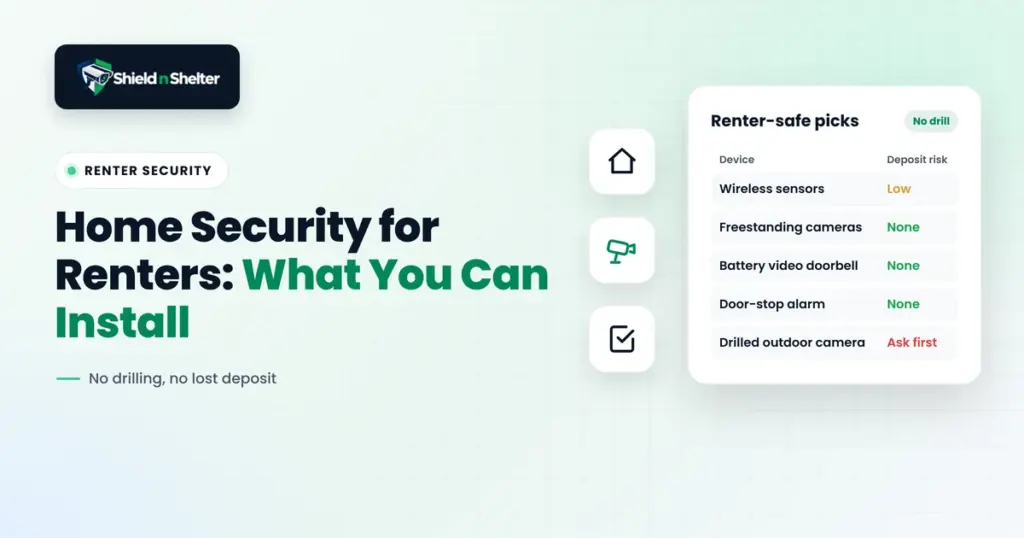
That’s easy. You find ways to install security equipment without drilling into anything. Here’s a brief overview of five such ways that you can use to monitor home security without drilling:
Wireless Sensors
Pros: Doesn’t require any drilling. Cons: Might chip paint or damage the plaster.
Wireless sensors are usually placed on the primary entryways such as doors and windows. They can be attached to the frames using double-sided adhesive tape.
You can control and check up on house activities by remotely monitoring the sensors with your smartphone. However, motion sensors can often provide false alarms, which can be annoying (here is how to eliminate false alarms).
Freestanding Indoor Cameras/Nanny Cams
Pros: No drilling and no chipping, i.e., no damage to paint. Cons: Might hamper the privacy of community members unknowingly.
Freestanding home cameras or as some call them, nanny cams, can be placed anywhere without any drilling or mounting. As such, they are often a renter’s best friend.
They are like mini robots that quietly observe your living space like sentries. You won’t even know that they are there unless you explicitly look for them.
You can place them on a high shelf, desk, or even a bookcase to monitor in-house activities. While choosing such home cameras, make sure it comes with motion alerts, privacy controls, and local recording options. While placing, choose an angle that covers the essential hotspots.
Removable Video Doorbells
Pros: Battery-powered, no drilling required, no permanent wiring. Cons: Might film shared corridors, battery needs to be replaced often, etc.
If you want to keep a record of visitors, you should go for battery-powered video doorbells. Generally, doorbells require permanent wiring as they are connected to the central electric panel.
However, with the removable video doorbells, you don’t have to worry about that. As they’re battery-powered, they’ll function even when electricity is out.
However, you may accidentally monitor shared corridors and take videos of other community members which is a violation of their privacy. So, it’s best to take permission from your landlord first and adjust camera placement/angle accordingly.
Portable Door-Stop Alarms
Pros: Compact, easy-to-use, no drilling or mounting required. Cons: Easy to bypass, doesn’t record audio or video for future recognition.
If you have a basement door, a garage door, a cellar door, or a similar entryway that’s not often used, you can place portable door-stop alarms underneath those doors.
The alarms go off when someone opens these doors, i.e., when the doors push against the doorstop. These are particularly useful for vacation rentals. When you’re away, you’ll receive in-app notifications that someone has breached these entryways without your knowledge.
Though these alarms are renter-friendly and don’t require any installation cost, it’s important to remember that these are not remotely as functional as actual door locks and alarm systems.
Wireless Alarm Setup
Pros: Compact, offers remote monitoring, and in-app notifications are available. Cons: May require subscriptions, may not function without an active internet connection.
You can also find completely wireless alarm kits for an affordable price for a functional apartment security system. These kits usually come with a set of motion sensors and you can use a central hub/app to control/monitor all settings around the house.
The only downside is that the advanced alarm kits require you to subscribe to access their premium features. So, if cost isn’t an issue, this can be a solid all-in-one option for renters.
Because if you’re not particularly tech-savvy and try to manage all the sensors by yourself, you’ll run right into issues like Ring motion alerts going off all day.
Do You Need All These Devices?
No, even if you can afford them, you don’t need all these security devices. Renter home security is not about extravagance, rather it’s about strategic planning and placement.
To know which security measures work best for you, you must first ask yourself:
- What’s the blueprint of my apartment? What goes where? What are the major entrances?
- What are the overlooked areas in my house? (e.g. garage, basement, ventilator shaft, etc.)
- What are the existing security features in my house?
- What’s my budget? How much can I afford to spend on security systems every month?
- How much monitoring do I want in my house/apartment?
Also, remember that too many cameras don’t equate to foolproof security. It’s best to go over our guide to security camera placement by room for strategic camera placement for maximum coverage.
How To Ask Permission From Your Landlord?
You typically need landlord permission if you’re looking to:
- Drill into walls/door frames/windowsills, etc.
- Replace/rekey existing locks.
- Install security devices that require permanent wiring.
- Mount outdoor security cameras.
- Mount home cameras in shared spaces.
- Install smart locks/alarm systems, etc.
To ask (and ensure) permission from your landlord, employ the following tactics:
- Be polite, keep the request simple and to the point.
- Explain clearly what you want to install, where you want to install, and how you want to install it (reiterate that it will be removable/won’t require drilling or permanent wiring).
- Discuss openly about covering shared spaces and adjust the location accordingly.
- State clearly that you’ll be solely responsible for equipment damage.
Can You Lose Your Security Deposit Over Unplanned Installations?
Yes, if you cause damage to the rental property, you can lose your security deposit at the end of your tenancy. To avoid that, here are some expert tips:
- Never go for unplanned security installations. If the landlord finds out, they can penalize you for not informing them. They can even file for breach of privacy.
- Always remove the temporary security installations before you leave.
- If you mount something and it damages the paint, repaint before leaving.
- Even something as small as adhesive tape can chip the paint or damage the plaster. So, check carefully before leaving and repair the damage as needed.
- Preserve permission documents, equipment receipts, etc. for safety purposes.
The Shield N Shelter Approach For Renter Home Security
Shield N Shelter focuses on DIY Security Planning and that extends to rental home security as well. The approach covers the following important steps:
Step 1: Mapping The Essentials
The first step is to document everything inside the house/apartment. It’s important to map all the rooms, all the corners, all the entryways, all the corridors, and how they connect to each other.
Step 2: Placing The Central Camera
Every house has a heart, i.e., a central location. Most often, it’s the living space or the corridor leading to it. The second step is to place a freestanding home camera here and then based on the coverage, place the other ones. Important locations include – by the main door, windows, corridors, backyard entrances, etc. The goal is to avoid home security blind spots completely.
Step 3: Improve As Needed
Once the central cameras are in place, additional measures can be taken. Such as, doorstop alarms, motion sensors, doorbell cameras, subscription-based alarm kits, etc.
Final Thoughts
Renting doesn’t have to equate to less security. With strategic planning, you can ensure an optimal apartment security system, protect your security deposit, move out your temporary devices safely when your lease comes to an end, and reconfigure them in the new house.
There’s only one rule: choose non-invasive installations. And always keep your landlord in the loop, so there’s no room for miscommunication. In short, the smartest renter home security setup is never about expensive security devices, rather open communication & lease-safe adjustments!