
A door that automatically locks when closed can seem highly convenient. You don’t have to worry about taking the time to lock it manually every day. When you leave the house, the door just automatically locks up behind you.
But what if your doors aren’t supposed to auto-lock? Instantly, it can turn into a nightmare. What if you get locked out?
Or worse, what if you get locked inside when there’s a fire in the house?
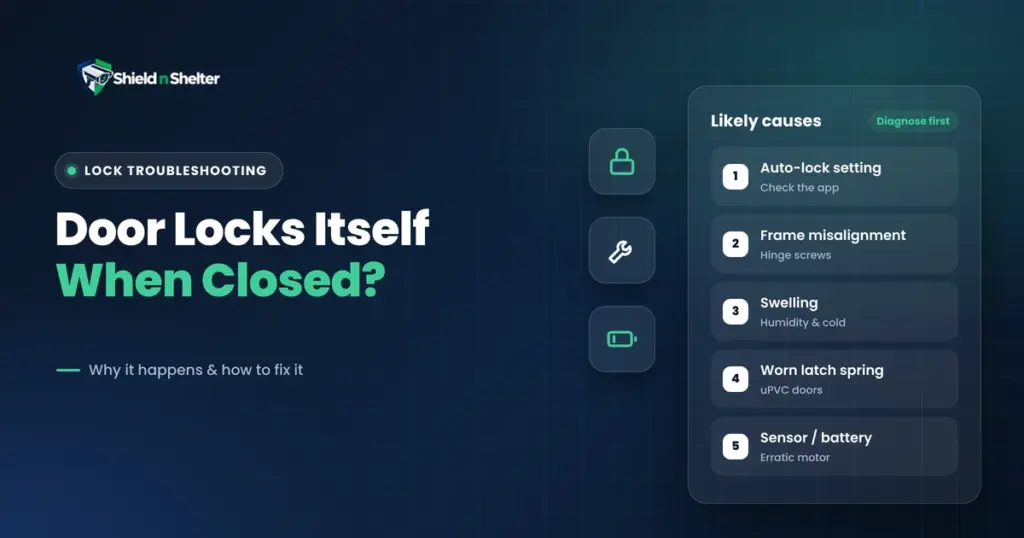
There are multiple root causes behind auto-lock events. Firstly, you may have a smart lock setting that you’re not aware of. Secondly, it could be a structural issue – such as misaligned doors, worn-out mechanisms, etc.
If you haven’t enabled any auto-lock features, but the door automatically locks anyway, then you shouldn’t take this lightly.
But before you attempt to DIY through the mess or call for professional help, you should first identify the specific root cause behind the automatic lock.
In this guide, we’ll go through the hows and whys of doors automatically getting locked, as well as quick and safe-to-attempt repair guidelines.
Why Do Doors Automatically Lock When Closed?
Doors can lock by themselves for several reasons. For instance:
- The deadbolt auto-locks. This is a common occurrence and happens more than you might expect with smart locks. It can happen if you accidentally turn on the automation settings or someone with app-control access does it without your knowledge.
- Door or frame misalignment. If the door is misaligned, the pressure falls on the hinge screws. Over time, they can loosen up, and the frame can descend slightly. This misalignment can cause bolts to get stuck. The jammed bolts, in turn, can make it harder for you to open the door.
- Swelling due to weather and humidity. Wooden frames can expand if they are exposed to a damp climate for a long time. This is not uncommon for doors made up of composite material either. Again, in cold weather, the situation reverses (the same cold that hits security cameras in cold weather). The previously expanded frames may shrink in size and cause misalignment. The bolts can then get jammed into place, and you can mistake it for auto-locking.
- Worn-out latches and springs. This is a common issue with uPVC doors. Over time, the latch wears out. The faulty spring doesn’t allow the handle to retract fully. As a result, bolts get jammed into place.
- Multi-point lock misalignment. If your door contains several hooks or rollers, the edge can warp over time and cause misalignment. It’s like a domino effect; one misalignment locks up the entire arrangement.
- Faulty door sensors or low-battery troubleshooting. If you don’t use the auto-lock feature and the door auto-locks anyway, then this is likely the issue. Faulty sensors may behave erratically, and the motor may malfunction due to weak or malfunctioning batteries.
How To Detect The Root Cause Behind It?
Firstly, we’d suggest running an open-door test.
This will help you identify whether the issue lies in the door or the lock. Open the door normally by hand or by app (if you use a smart lock), and then close it in the same way. Look for sluggish behaviour.
If the latch or bolt behaves normally in an open state, but struggles to fit in when you try to close the door, it’s most likely a misalignment issue.
Alternatively, if the latch or deadbolt behaves erratically even when you try to open it normally, or gets stuck midway, then it’s a faulty lock mechanism.
Again, if you use a smart lock, we’d suggest monitoring the app activity. Check to see whether you’ve turned on the auto-lock settings, and turn it off.
You should also check the battery health and replace the batteries if necessary. At the same time, check the built-in door sensors as well.
Sometimes dirt and dust accumulation can cause the magnetic sensors to malfunction. A little clean-up, in this case, can perk them right up.
To detect misalignment issues, you should check for gaps and whether the bolt lines up with the strike. Also, check for swelling around the edges.
Lastly, check the handle for a worn-out spring/spindle. Does it extend all the way when you pull it? Does it drop midway? Find the answers.
Another telltale sign of a spring issue is that the bolt stays stuck in a certain position when you pull the handle. Jammed bolts can lock the door by themselves.
How To Fix Doors That Lock Automatically?
Now that you know the common causes, let’s look at some of the solutions:
- Change Smart-Lock Settings. Either turn off the auto-lock feature or lengthen the delay. If the auto-lock was turned on without your knowledge, go through the access history and change your password. Make sure only trusted people have access. If the smart lock’s battery health is down, replace the batteries with new ones. Recalibrate the door sensors if they’re acting up and clean the edges. Check the smart lock settings most homeowners never touch for more ideas.
- Refurbish The Hinge Screws. To combat misalignment, tighten the hinge screws for better positioning. If that doesn’t work, take apart the hinge, replace the screws with longer ones so they bite into the frame steadily and prevent the door from sagging. Adjust the strike plate position as well to make sure the bolt goes in smoothly.
- Seal Off Edges To Prevent Swelling. Use waterproof sealing on the edge of the frames so they don’t expand in a damp climate. You can also use a dehumidifier to get rid of the excess moisture.
If you are a new homeowner experiencing these issues and feel clueless about the whole thing, our new homeowner security setup guide can help you divide the task list into segments and clear them one by one.
When To Give Up & Bring In The Big Guns?
A door that locks by itself can readily become a security threat. In such cases, instead of handling it by yourself, it’s best to call a licensed locksmith.
Do so if you notice:
- A latch/spring/spindle problem. You’ll need to take apart the handle, so it’s best if a locksmith handles it. If it’s a spring issue, they’ll replace the loose one. If it goes deeper, they’ll change the entire lockset.
- A multi-point system malfunction. Call a locksmith if the hooks and rollers don’t line up or if there’s warping around the edges. Adjusting such door locks requires great skill and thus needs a professional.
- Cylinder and motor issues. If a key snaps in the cylinder or the motor acts erratically, call a locksmith to resolve the situation.
- Repeated lock failures. If you have fixed the alignment, but the door auto-locks again after a few days, get the opinion of a locksmith.
A trained locksmith will help you discover the core issue so you can fix it once and for all. A second pair of eyes can always help out, especially when you fix home security system problems and repel safety issues.
The Shield N Shelter Approach: Find The Right Fit For Your Home
Unsure about the right type of door lock for your home?
Should you just play it easy and go for the manual latch and bolt? Or do you want to invest in a smart auto-lock instead? It’s a big decision, indeed.
Fear not, that’s precisely the type of service Shield N Shelter is here to offer. We firmly believe that all your security components should be reviewed as a single system, i.e. they should work with each other & not against each other.
In light of that, our consultants will review the blueprint of your house initially. Afterwards, they will design an overall security system with the type of door-lock mechanism that best complements the rest of the setup.
Still hesitant? You can check out our Smart Home Security Design service to learn more about lock and IoT planning. And when you’re ready, you can book a virtual assessment to receive a full audit report promptly.