
Here’s an uncomfortable truth about home security: most people have no idea how good their front door lock actually is. They might know the brand. They know it turns. They don’t know if it’s a basic type of door lock sold at the hardware store or a well-tested, breakproof deadbolt.
And that’s not the best news. So let’s fix that.
This isn’t a how-to-break-in guide or about being vulnerable; it’s about being secure with an explanation of what the grades on the box actually represent, and which cheap security upgrade is the most beneficial.
No locks are marketed here, no manufacturer sponsors us (sadly), and we make no money based on the brand you choose (gladly). Schlage is included here merely as an example; it is one of the most widely used locks on American doors!
First, Understand ANSI/BHMA Grades (They Matter More Than the Brand)
If a lock is a Grade 1, don’t just assume it’s for marketing purposes. It’s a result of independent testing against ANSI/BHMA standards, written by the Builders Hardware Manufacturers Association. The grade indicates the degree of punishment the lock has endured in a laboratory: repeated open/close cycles, hammer strikes, and a tremendous amount of force applied to the locking bolt.
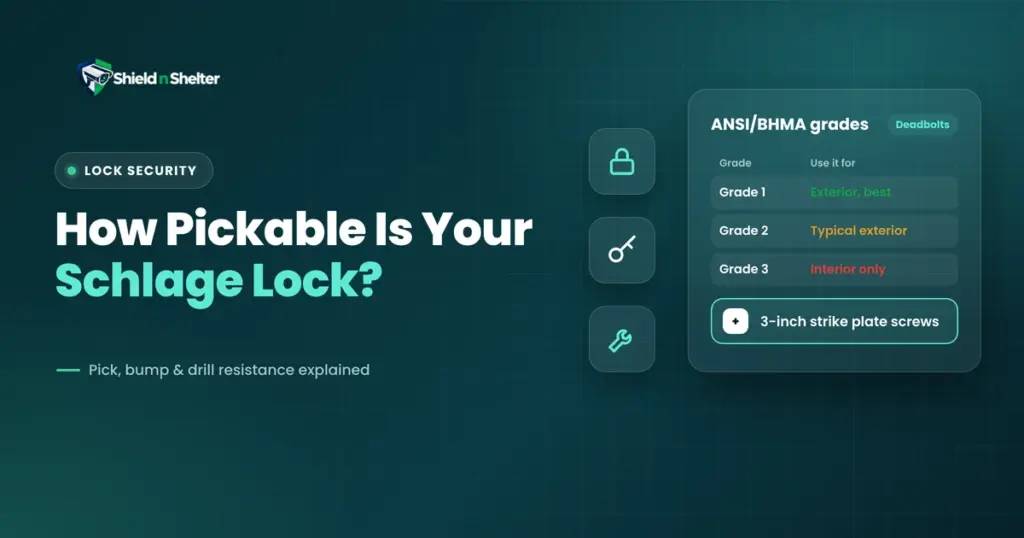
Here’s the quick version for deadbolts (standard A156.36):
| Grade | What it means | Where it belongs |
|---|---|---|
| Grade 1 | Highest rating. Around 250,000 cycles, plus the toughest strike and force tests | Exterior doors, anywhere you want highest protection |
| Grade 2 | Solid residential protection, a step down on cycles and strike tests | Typical exterior doors |
| Grade 3 | Basic, builder-grade | Interior doors, not your front door |
The number of tests is not exactly defined for each tier, so if you want to be specific for a purchase or a code requirement, refer to the code itself. The ranking, however, is universal: A grade 1 lock is better than a grade 2 lock, and a grade 2 lock is better than a grade 3 student.
For example, a quick Schlage example: If the B60 deadbolt is sold as ANSI/BHMA Grade 1, the B560 deadbolt is sold as Grade 2. One same brand – different tested tier.
Our advice would be to check the grade rather than the logo.
What Security Pins Actually Do
A standard key lock has tiny spring-loaded pins. Only the proper key will lift each pin to the proper height. Simple locks have simple pins and are easier to manipulate with the wrong tool.
Security pins are redesigned pins, typically referred to as “spool pins” or “serrated pins,” that are created to provide false feedback or to hook upon a shot to manipulate with keys other than the one it is designed to accept. You never see them with your own key. They are only a concern if somebody is attempting to break the lock without it.
Security pins make a lock more difficult, but not impossible. Anyone promising to sell you ’unpickable’ is overpromising, and no lock can be picked. Opportunistic burglars are deterred by the time and difficulty of the pins. The time and difficulty of the pins are what deter the opportunistic burglar. Increasing the number of pins (five or six pins) and adding security pins helps to raise that bar.
Bump Keys, Drill Attacks, and Snap Attacks
There are, in fact, three types of attacks that are encountered quite frequently, and here’s what they mean for owners.
Bump vulnerability. A weakness of regular pin-tumbler cylinders is bump keys. You don’t have to learn how to operate them to defend against them. All you have to do is find a cylinder that’s bump-resistant, which is what most quality deadbolts, such as Schlage’s B-series, claim. Check the spec sheet rather than take it for granted.
Drill resistance. The goal of the game in drilling is to eliminate the cylinder from the front. Better deadbolts have inserted hardened steel plates or anti-drill plates that make it hard to drill. Without them, a cheap lock is much more susceptible.
Snap resistance. The euro-profile cylinders are dominant in the UK and Europe, and are the common targets of snap attacks. If it’s your door, check for an anti-snap rating (TS 007 (3-star)) or Sold Secure. US-type deadbolts are less vulnerable to this type of attack, but be sure to check the type of cylinder, not assume.
Another design feature: A good deadbolt will have at least one inch of bolt throw, and the best will also be equipped with hardened bolts that are resistant to sawing and kick-in.
How to Read a Lock’s Spec Sheet
The list of what you need will be provided in the box, the manual, or the manufacturer’s product page. Look for:
- ANSI/BHMA grade (A156.36 for deadbolts, A156.2 for knob and lever sets)
- Security, Durability, and Finish ratings. Schlage lists “Grade AAA” under A156.40, meaning top marks in all three
- Bolt throw (1 inch is the standard to look for)
- Pin count and whether anti-pick security pins are included
- Anti-drill and anti-pick features (steel plates, shields)
- Strike reinforcement, which brings us to the real weak point
Self-Check: What Grade Is On Your Door Right Now?
Do this in five minutes:
- Find the model number. Check inside the lock body or the original locking case, or unlock the door and examine the edge of the deadbolt (the faceplate). A B60 or B560 model notifies you of the product line.
- Look it up on the manufacturer’s site and note the stated ANSI/BHMA grade. When no grade is public, consider it to be ungraded and make plans to upgrade.
- Check the deadbolt throw. When extended, does the bolt stick out about an inch into the frame?
- Check the strike plate. Look at it (the metal plate in the door frame to which the bolt attaches). This is the most important step that most owners will overlook.
The Real Failure Point: Your Strike Plate Screws
This is something that most break-in security tips do not mention, but in a kick-in, the lock is typically not the culprit. The door frame is. A Grade 1 deadbolt that’s secured with tiny screws is as sturdy as the thin trim wood the screws are in.
Strike plates come with screws that are about 3/4″ long. They only hold onto the door frame, which is part of the jamb. Substituting 3″ screws that extend to the wall stud behind the jamb with the structural framing will secure the strike plate, rather than the decorative wood. It takes about $5 and 10 minutes using a drill.
Repeat with your hinge-side screws on your door, as this is another weak spot. If your door uses a keypad, also review your keypad door locks settings. A steel strike reinforcer plate distributes the force over the frame for added protection.
If your lock is Grade 1 but your strike plate is held with short screws, you’ve bought the strongest lock and installed it in the weakest spot. Fix the screws first.
Locked Out? Call a Licensed Locksmith
If you are reading this as a result of being locked out, do not attempt to break your lock and don’t look for any shortcuts! It’s likely that you will rip a hole in the door or tear the cylinder, and a hole in the door is far more expensive than a service call. If you need a locksmith to open the door, make sure to hire a licensed one, request his license and ID when he arrives, and demand evidence that he is living there. It’s a mandatory requirement of any trustworthy locksmith.
A red flag is if one does not.
The Bottom Line
Your front door’s security comes down to a short list: a Grade 1 or Grade 2 deadbolt, a spec sheet showing real anti-pick, anti-bump, and anti-drill features, a one-inch bolt, and a strike plate anchored with 3-inch screws into the stud. That assortment beats an expensive lock sitting in a weak frame every time.
If you’d like an independent assessment of every door in your home, with no hardware to sell you, that’s exactly what a virtual home security audit covers.